
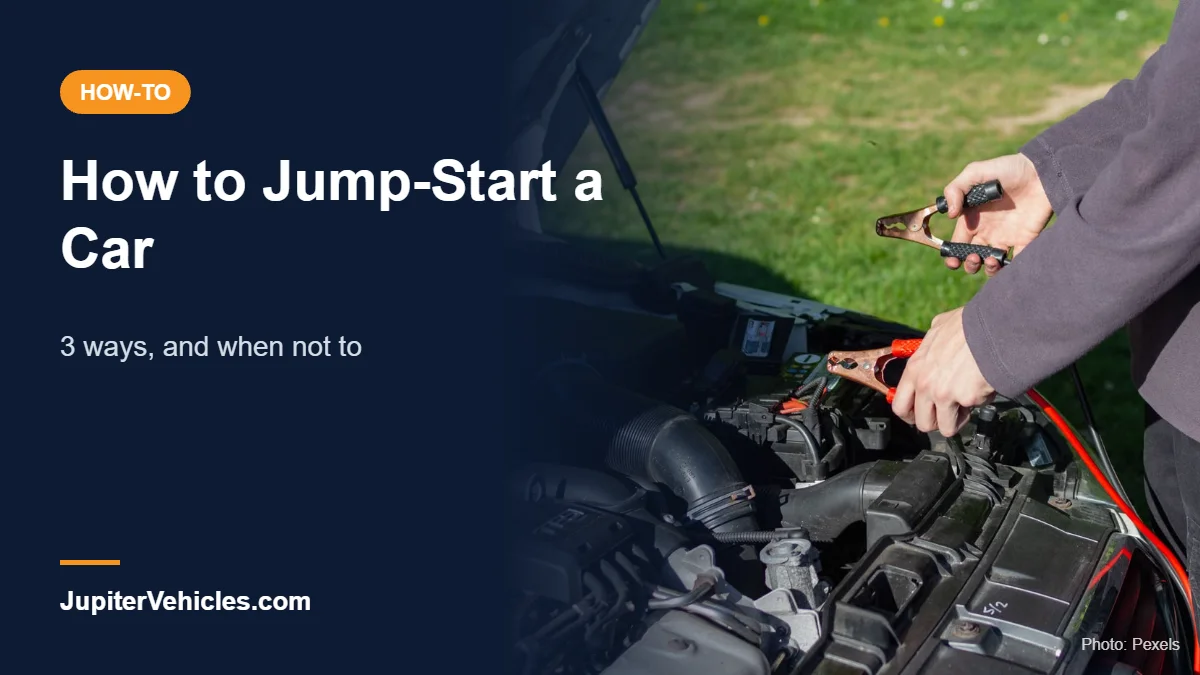
How to Jump-Start a Car: 3 Ways, Which to Use, and When Not To
JupiterVehicles is reader-supported. As an Amazon Associate, we earn from qualifying purchases.
A dead battery is one of the most common reasons cars won’t start. Consumer Reports, citing AAA, notes that battery-related roadside calls still topped 5.7 million in 2024. The good news: you can usually get going again in minutes with the right method.
There are three main ways to jump-start a car. This guide helps you pick the right one and gives the short steps for each, with links to our detailed guides.
Table of Contents
Before You Jump: When Not To
Don’t try to jump-start a car if:
- The battery is cracked, leaking, swollen or frozen
- You smell rotten eggs (sulfur) near the battery
- The battery terminals are badly corroded and you can’t get a clean connection
- Your owner’s manual says the car needs a special procedure you can’t follow
Consumer Reports’ jump-start guide quotes AAA warning that jump-starting a damaged or frozen battery could cause significant damage to the vehicle and harm people nearby. When in doubt, call roadside assistance.
The 3 Ways to Jump-Start a Car
| Method | What you need | Second car? | Best for |
|---|---|---|---|
| Portable jump starter | A charged jump pack | No | Most drivers, roadside emergencies |
| Jumper cables | Cables and a running donor car | Yes | When someone can help |
| Charger with engine start | A charger with an engine start mode and a wall outlet | No | At home or in a garage |
Method 1: Portable Jump Starter (Easiest)
- Turn off the car and accessories.
- Connect the red clamp to the positive (+) terminal.
- Connect the black clamp to a ground point or the negative (-) terminal, as your manual directs.
- Turn on the pack and wait for the ready light.
- Start the car, then remove the clamps (black first).
Full details: how to jump start a car with a battery pack.
Method 2: Jumper Cables and a Second Car
- Park the donor car close, without the cars touching. Turn both off.
- Red clamp to the dead battery’s positive (+), then to the good battery’s positive (+).
- Black clamp to the good battery’s negative (-), then to a bare metal ground on the dead car, away from the battery.
- Start the donor car, then the dead car.
- Remove cables in reverse order.
Full details: how to use jump cables to start a car.
Method 3: Battery Charger With Engine Start
Some battery chargers have an engine start mode that delivers a short burst of high current. You connect the charger, select engine start, wait as the manual directs, then crank. This works only where you have a wall outlet.
Full details: how to jump start a car with a battery charger.
Which Method Should You Use?
- Stranded alone: a portable jump starter.
- Someone can help: jumper cables work fine.
- At home with a dead battery: a charger with engine start, or charge the battery fully.
- Push-starting a manual? It’s possible on some older manual cars but risky and not recommended for most modern cars. Check your manual first.
After the Car Starts
Consumer Reports recommends letting the car run for at least 20 minutes to let the battery recharge before shutting it off. If it still won’t start, there may be another problem, such as the starter or alternator. If the battery keeps dying, have it tested. AAA says car batteries typically last three to five years, depending on use and temperature.
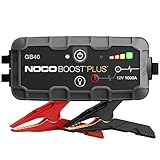
- START DEAD BATTERIES — Instantly start dead batteries with 1000 amps of peak lithium power. Up to 20 starts per charge on engines up to 6.0L gas and 3.0L diesel.
- ULTRASAFE TECHNOLOGY — Engineered with patented spark-proof and reverse polarity protection for foolproof connections to any 12V vehicle - no sparks, no wrong connections.
- PORTABLE POWER BANK — Integrated power bank delivers emergency power to smartphones, tablets, and more. Recharges in 3 hours so it’s ready when it matters most.
- INTEGRATED LED FLASHLIGHT — Precision-engineered 100-lumen LED with 7 light modes, including SOS and strobe. Illuminate repairs, emergencies, or low-light environments.
- COMPACT YET POWERFUL — High-discharge lithium technology delivers exceptional starting performance in a compact 2.5 lb form factor - perfectly sized for glove boxes and emergency kits.

Frequently Asked Questions
What’s the safest way to jump-start a car?
A modern jump starter with reverse-polarity and spark protection is the simplest. Always follow your owner’s manual.
Which cable goes on first when jump-starting?
Red (positive) goes on first, starting with the dead battery. Black goes last, to a ground point on the dead car.
How long should I leave the car running after a jump?
At least 20 minutes, according to Consumer Reports, or take a drive so the alternator can recharge the battery.
Can you jump-start a car in the rain?
Yes, with care. Keep clamps from touching each other or the car body, and avoid standing in deep water.
Why won’t my car start after a jump?
Check the clamp connections first. If it still won’t start, the battery may be damaged, or the starter, alternator or fuel system may be the problem.
The Bottom Line
To jump-start a car, use a portable jump starter if you’re alone, jumper cables if someone can help, or a charger with engine start at home. Skip the jump if the battery is damaged or frozen, follow your owner’s manual, and drive for at least 20 minutes afterward.


One Comment