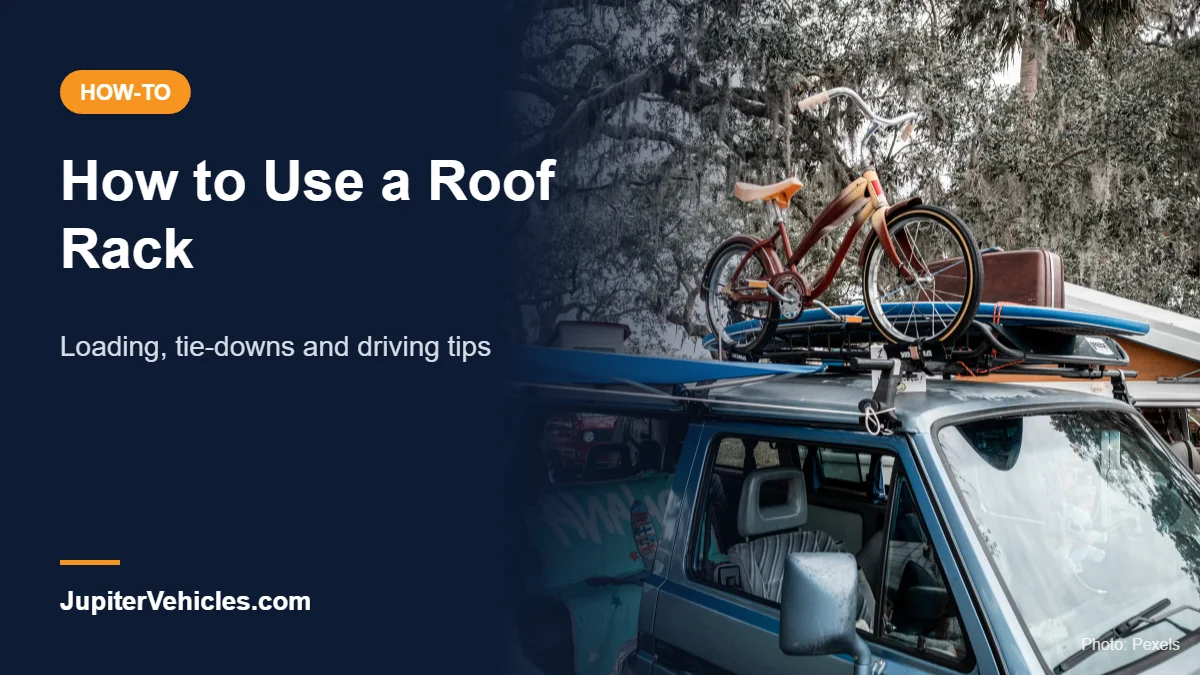
How to Use a Roof Rack: Loading, Tie-Downs and Driving Tips
JupiterVehicles is reader-supported. As an Amazon Associate, we earn from qualifying purchases.
A roof rack is only as safe as how you load it. Most problems come from too much weight, loose straps or forgetting about the extra height. This guide covers how to use a roof rack day to day once it’s installed. For setup, see how to install a roof rack.
Table of Contents
Step 1: Know Your Limits
Thule explains that the maximum roof load is the rack’s weight plus accessories plus the load itself, and that the lowest of the rack’s or vehicle maker’s limits always applies. Find your vehicle’s roof load limit in the owner’s manual and stay under it.
Step 2: Pack Smart
- Put heavy items inside the car and lighter, bulky items on the roof.
- Center the load and spread weight evenly between the bars.
- Use a cargo box or roof bag for loose gear. See rooftop cargo box.
Step 3: Use the Right Tie-Downs
- Cam straps: best for most roof loads. Hard to overtighten.
- Ratchet straps: use carefully. Overtightening can damage boats, boards or crossbars.
- Bow and stern lines: use them for kayaks and canoes.
- Avoid stretchy bungee cords as your main restraint.
- Twist flat straps once to reduce humming in the wind.
Carrying Common Gear
| Gear | How to carry it |
|---|---|
| Luggage | Cargo box or roof bag |
| Bikes | Roof bike mounts on the crossbars |
| Kayaks and canoes | J-cradles or saddles, cam straps, bow and stern lines |
| Skis and snowboards | Ski carriers with locks |
| Lumber or ladders | Work racks or bars rated for it, with front and rear tie-downs |
Step 4: Check Before and During the Trip
- Tug on every strap and accessory before leaving.
- Recheck after the first few miles and at every stop.
- Look for strap wear and loose bolts.
Step 5: Drive Differently
- Mind your height: garages, drive-thrus and parking structures.
- Slower in crosswinds: roof loads catch wind.
- Gentler braking and cornering: a higher center of gravity changes handling.
- Expect lower fuel economy: FuelEconomy.gov says a large roof-top cargo box can cut fuel economy by about 10% to 25% at Interstate speeds.
Step 6: Remove What You Don’t Need
Take off boxes, mounts and even crossbars between trips to save fuel and reduce noise.

- 【100% Waterproof & Heavy-Duty Material】 Made with upgraded durable 840D PVC material and high-frequency welded seams, features a double-layered waterproof cover, this rooftop cargo carrier keeps your luggage dry even in heavy rain, snow, or long-distance travel. Built for road trips, camping, and family vacations.
- 【21 Cubic Feet Extra Storage Space】 Expand your vehicle’s storage instantly. The large 21 cubic feet roof top cargo bag (52 x 40 x 18 inches) easily fits 4–6 suitcases, tents, sleeping bags, and travel gear, free up inside vehicle space for more comfortable on the way.
- 【More Secure with 10 Reinforced Straps & 6 Door Hooks】 Upgraded safety system includes 10 reinforced straps, 6 door hooks and anti-slip mat for stronger stability at highway speeds and prevent scratch from your car simultaneously. Keeps the roof bag firmly in place even on long drives or windy conditions.
- 【Fits All Vehicles With or Without Roof Rack】 Designed to work with cars, SUVs, vans, and trucks — no matter if you have side rails, crossbars, or no rack at all. Quick installation in minutes.
- 【Complete Travel Kit Included】 Comes with anti-slip mat, luggage lock, reinforced straps, door hooks and storage bag for easy setup, safe travel, and compact storage when not in use.
Frequently Asked Questions
How much weight can I put on my roof rack?
The lowest of your rack’s rating and your vehicle’s roof load limit, including the rack’s own weight.
Can I put luggage directly on a roof rack?
Use a cargo box or bag. Loose luggage can shift or get wet.
How do I stop straps from humming?
Twist each flat strap a few times between anchor points.
Is it safe to drive on the highway with a roof rack?
Yes, if the load is within limits and secured. Drive a little slower in wind.
The Bottom Line
To use a roof rack safely, stay under the lowest load limit, keep heavy items inside, use cam straps and proper mounts, recheck straps during the trip, and drive with the extra height and wind in mind.