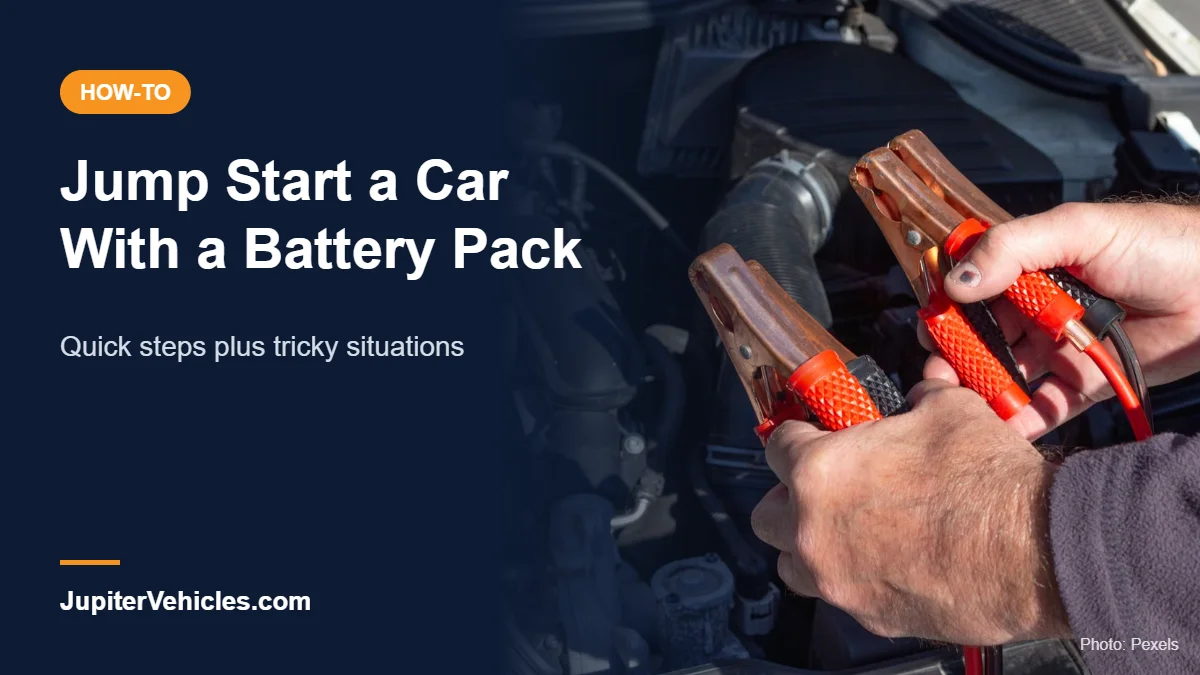
How to Jump Start a Car With a Battery Pack (Including Tricky Situations)
JupiterVehicles is reader-supported. As an Amazon Associate, we earn from qualifying purchases.
Jump-starting a car with a battery pack takes about five minutes when everything goes right: clamp on, power up, start the engine. Problems usually come from the situation, not the pack. The battery is too dead for the pack to detect, it’s hidden under a seat, it’s freezing outside, or the car is a hybrid.
This guide gives you the quick steps first, then walks through the tricky situations. For a fully detailed walkthrough of the basic process, see our guide on how to use a portable jump starter.
Table of Contents
The Quick Steps
- Turn everything off. Ignition off, lights off, climate off, and unplug phone chargers.
- Check the pack. Make sure it shows enough charge, ideally more than half.
- Connect the red clamp to the positive (+) battery terminal.
- Connect the black clamp to the negative (-) terminal or an unpainted metal ground point on the engine or chassis, following your owner’s manual.
- Turn on the pack and wait for the ready light.
- Start the car. Crank for no more than a few seconds at a time. If it doesn’t start, wait a minute or two before trying again so the pack can recover.
- Disconnect in reverse order: black clamp first, then red.
- Keep the engine running and drive to give the alternator time to recharge the battery.
Consumer Reports’ jump-start guide is a good refresher on the basics, including when to call for help instead.
Situation 1: The Battery Is Too Dead for the Pack to Detect
Many smart packs won’t send power unless they detect some voltage from the car battery. That’s a safety feature, but it means a completely flat battery may get no response.
- Double-check that the clamps have a solid grip on clean metal.
- Look for a boost, override or manual mode on your pack. It forces power to the clamps even when no battery is detected.
- Before using boost mode, confirm the clamps are on the right terminals. Boost mode bypasses some protections, including reverse-polarity detection on many packs.
- Follow your pack’s instructions for how long boost mode stays active.
Situation 2: You Can’t Reach the Battery
Some cars put the battery in the trunk, under a seat, or under the floor. These cars usually have remote jump-start terminals under the hood: a positive post (often under a red cap) and a ground point.
- Check your owner’s manual for the jump-start terminal locations.
- Connect the red clamp to the remote positive post and the black clamp to the marked ground point.
- If your pack’s cables are short, park the pack on a stable surface near the terminals.
Situation 3: It’s Freezing Outside
Cold reduces the power of both your car battery and the jump starter.
- If possible, warm the jump starter inside your home or a warm car before using it.
- Use a pack rated above your engine size. Our guide on what size jump starter you need explains how much headroom to allow.
- Give the pack a minute or two connected before cranking, if its instructions allow.
- Crank in short bursts with rests between tries.
Situation 4: Push-Button Start Cars
Push-button cars jump-start the same way. Connect the pack, turn it on, then press the start button with your foot on the brake (or the clutch in a manual). If the dash lights flicker but the engine doesn’t crank, check the clamp connections first.
Situation 5: Hybrids and Electric Vehicles
Hybrids and EVs have a small 12V battery for electronics as well as the high-voltage drive battery. When the 12V battery dies, the car won’t power on.
- Follow the jump-start procedure in your owner’s manual exactly.
- Connect only to the 12V battery or the designated jump-start terminals.
- Consumer Reports warns never to use a jump starter on the high-voltage drive battery of an EV, plug-in hybrid or hybrid.
Situation 6: The Engine Clicks but Won’t Start
- Rapid clicking: the starter isn’t getting enough current. Recheck clamps, make sure the pack is charged, and try boost mode if needed.
- One loud click: could be a starter motor or connection problem rather than the battery.
- Cranks but won’t fire: the battery may be fine. The problem could be fuel, ignition or security system related. A code reader can help. See what is OBD2.
After the Car Starts
- Drive for a while rather than idling, so the alternator can recharge the battery.
- If the car needed a jump for no obvious reason, such as lights left on, have the battery and charging system tested. Many auto parts stores do this.
- Recharge your jump starter as soon as you can so it’s ready next time.
Which Battery Pack to Keep in Your Car
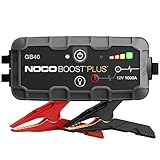
- START DEAD BATTERIES — Instantly start dead batteries with 1000 amps of peak lithium power. Up to 20 starts per charge on engines up to 6.0L gas and 3.0L diesel.
- ULTRASAFE TECHNOLOGY — Engineered with patented spark-proof and reverse polarity protection for foolproof connections to any 12V vehicle - no sparks, no wrong connections.
- PORTABLE POWER BANK — Integrated power bank delivers emergency power to smartphones, tablets, and more. Recharges in 3 hours so it’s ready when it matters most.
- INTEGRATED LED FLASHLIGHT — Precision-engineered 100-lumen LED with 7 light modes, including SOS and strobe. Illuminate repairs, emergencies, or low-light environments.
- COMPACT YET POWERFUL — High-discharge lithium technology delivers exceptional starting performance in a compact 2.5 lb form factor - perfectly sized for glove boxes and emergency kits.

The NOCO Boost GB40 suits most cars with gas engines up to 6.0L. For bigger engines or diesels, see our list of the best rated battery jump starters.
Frequently Asked Questions
Do you connect the black clamp to the negative terminal or ground?
Either can work on most cars, but many manufacturers recommend an unpainted metal ground point away from the battery. Follow your owner’s manual and the pack’s instructions.
How long should I wait before starting the car?
Usually you can crank as soon as the pack shows ready. Some instructions suggest waiting briefly with a very weak battery. Crank for only a few seconds at a time.
Can a battery pack jump a completely dead battery?
Often yes, using the pack’s boost or override mode. If the battery is damaged or very old, it may not hold a charge and should be replaced.
How many times can I try to jump start a car?
Try a few short attempts with rests in between. If it still won’t start, the problem may not be the battery.
Should I leave the car running after a jump?
Yes. Drive it for a while to recharge the battery, and have the battery tested if it keeps dying.
The Bottom Line
Jump-starting a car with a battery pack is simple: red to positive, black to ground, power on, start, then disconnect in reverse. When it doesn’t work, the fix is usually a better clamp connection, boost mode for a dead-flat battery, the remote jump terminals for a hidden battery, or a bigger pack for cold weather.