How to Choose a Portable Car Vacuum: Buying Guide
A portable car vacuum can make it easier to remove crumbs from seat seams, sand from floor mats, pet hair from upholstery, and dust from the spaces around your center console. The problem is that compact vacuums can look remarkably similar online while offering very different levels of cleaning performance, battery life, and usability.
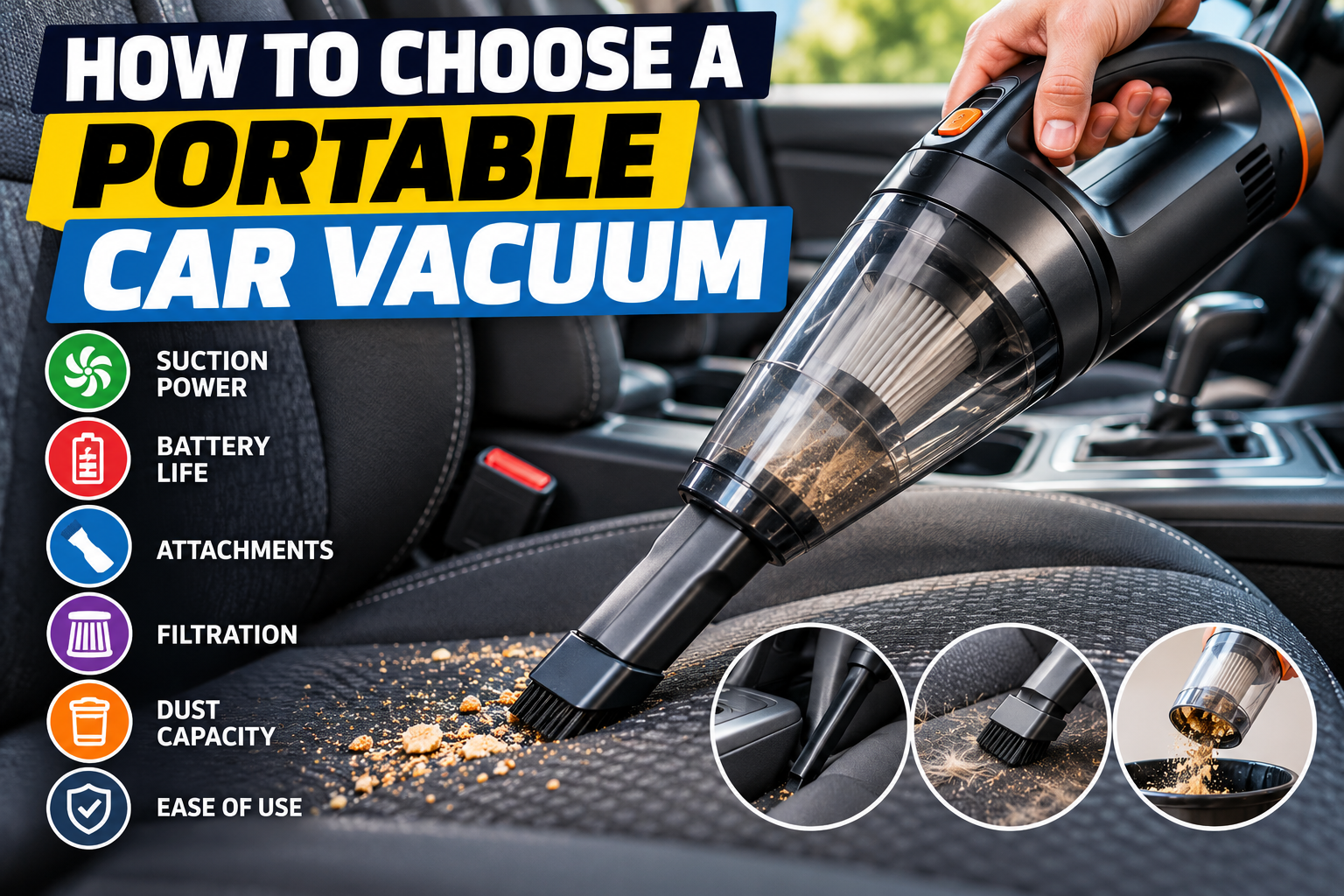
To choose the right one, start with the mess you clean most often. Then compare the power source, usable runtime, nozzle design, filtration, dustbin capacity, and maintenance requirements. A high advertised suction number is not enough on its own. If the nozzle cannot reach beneath a seat, the battery runs out halfway through cleaning, or the filter is difficult to replace, the vacuum may not be a practical choice.
For occasional crumbs and light dust, a small cordless handheld model may be all you need. Pet owners and drivers who regularly deal with sand or embedded dirt should pay closer attention to brush attachments, sustained cleaning performance, and the amount of time the vacuum can operate at its higher power settings. For heavily soiled interiors, a larger vacuum may be a better fit.
Table of Contents
1. Decide What You Need to Clean
Before comparing models, identify the types of debris and the areas of your vehicle that need the most attention. This simple step helps prevent you from paying for features you will rarely use while overlooking the ones that would make cleaning easier.
| Main cleaning task | Features to prioritize | What to watch for |
|---|---|---|
| Crumbs, dust, and everyday debris | Compact design, easy-empty dustbin, crevice tool | A bin that fills quickly or an awkward nozzle |
| Sand and dirt on floor mats | Consistent suction, useful nozzle width, sufficient runtime | Weak pickup on textured mats or repeated clogging |
| Pet hair on fabric seats | Compatible upholstery brush or motorized pet-hair tool | Hair wrapping around the brush or clogging the inlet |
| Dust around dashboard and console | Soft dusting brush, controlled airflow, lightweight body | Hard plastic attachments that may scratch delicate surfaces |
| Dirt under seats and beside seat rails | Long crevice nozzle or flexible extension hose | A bulky body that cannot fit into narrow spaces |
| Several vehicles or deep cleaning sessions | Longer practical runtime, larger bin, replaceable filters | Small batteries and frequent emptying |
Think about how often you clean, too. Someone removing a few crumbs after a commute has different requirements from a driver who regularly transports children, pets, sports equipment, or passengers in a rideshare vehicle.
2. Choose the Right Power Source
Portable car vacuums generally fall into three categories: cordless battery-powered models, corded vacuums that use a vehicle power outlet, and compact shop vacuums that plug into a household outlet. Each approach solves a different problem.
Cordless handheld vacuums
A cordless car vacuum is convenient when you want to clean without managing a cable. It is easy to carry around the cabin, and you can use it in a driveway or parking area without needing a nearby wall outlet.
The trade-off is battery dependence. Runtime decreases as the battery ages, and using the highest power setting may shorten a cleaning session considerably. Battery replacement availability, charging time, and the manufacturer’s recommended storage conditions deserve attention before you buy.
Choose cordless if convenience and quick access matter more than uninterrupted operation.
12-volt corded car vacuums
These models connect to a compatible vehicle accessory power outlet. They do not depend on an internal battery in the same way as cordless models, so they can be useful for extended touch-ups when the power supply remains available.
Check the manufacturer’s instructions for the required outlet, current draw, and operating conditions. Do not assume that every vehicle outlet supports every vacuum. Also consider cable length: a short cable can make the rear footwells and cargo area awkward to reach.
Never leave the vehicle running in an enclosed garage to power a cleaning session. Follow the vehicle manual’s guidance for accessory outlets and electrical equipment.
Compact shop vacuums
A small shop vacuum is worth considering if you clean your vehicle in a garage and frequently deal with sand, larger debris, or several vehicles in one session. Depending on the model, it may offer a larger collection tank, a hose, and more substantial attachments than a miniature handheld cleaner.
The disadvantages are bulk, storage space, and the need for a suitable external power source on corded versions. A wet/dry designation also does not mean every component or accessory can handle every liquid. Follow the model’s manual and never vacuum flammable liquids or other prohibited materials.
3. Understand Suction Ratings Before Comparing Models
Suction is an important part of vacuum performance, but advertised numbers can be misleading when they are compared without context.
Some manufacturers publish suction pressure in pascals (Pa) or kilopascals (kPa). Others publish air watts (AW), while product listings may also emphasize electrical watts or battery voltage. These measurements describe different things and should not be treated as interchangeable.
- Suction pressure: Describes the pressure difference a vacuum can create under specified conditions. A high figure alone does not tell you how effectively the machine moves air while cleaning.
- Air watts: A measure that combines airflow and suction pressure into a useful indication of air-moving power when measured consistently.
- Electrical watts: Describe electrical power consumption, not a direct measurement of how effectively debris is collected.
- Battery voltage: Describes part of the battery system. It is not, by itself, a reliable ranking of cleaning performance.
There is no universal suction-number threshold that guarantees a portable car vacuum will clean every interior effectively. Manufacturers may use different measurement methods, and performance also depends on airflow, nozzle design, filtration, seals, and how well the tool maintains pickup as the dustbin fills.
Instead of buying solely on the highest advertised Pa or kPa figure, look for credible testing that evaluates the specific model on realistic debris and surfaces. If independent test results are unavailable, treat the manufacturer’s figures as specifications to compare cautiously rather than proof of superior cleaning.
4. Check Battery Life at the Power Setting You Will Use
Battery runtime determines whether a cordless vacuum can finish the job without an interruption. A manufacturer may advertise a maximum runtime that applies only to a lower-power setting, so read the conditions behind the number.
Consider the difference between a quick cleanup and a full interior clean. Removing a handful of crumbs from a front seat may take only a short session. Cleaning four floor mats, both seating rows, seat seams, and a cargo area requires more time and may involve repeated use of a higher power setting.
When comparing cordless models, check the following:
- Runtime by operating mode: Find out whether the published figure applies to low, standard, or maximum power.
- Charging time: A long recharge may be inconvenient if you want to clean several times during the day.
- Battery replacement: Determine whether a replacement battery is available and whether the user can replace it safely.
- Charging method: Check the supplied charger, connector, and any charging requirements in the manual.
- Battery warranty: Review the actual warranty terms instead of assuming the battery receives the same coverage as the entire appliance.
A removable battery can be helpful for heavy users, particularly when replacements are sold separately. However, it is not automatically better if replacement batteries are expensive or difficult to obtain.
For a vehicle that sits outdoors in extreme heat or cold, do not assume that the vacuum should remain in the cabin permanently. Temperature limits vary by battery and product. Follow the manufacturer’s storage instructions and store the vacuum indoors when recommended.
5. Prioritize Attachments That Reach Difficult Areas
The shape of a car interior makes attachments more important than a product listing’s accessory count might suggest. Seat rails, narrow console gaps, stitched upholstery, and the space beneath seats all create places where a wide nozzle cannot reach easily.
Crevice tool
A long, narrow crevice tool is one of the most useful accessories for vehicle cleaning. It helps you reach between seat cushions, along console edges, and around seat rails.
Compare its length, width, and connection to the vacuum rather than assuming every included crevice tool will fit your car’s tightest spaces.
Upholstery brush
A brush attachment can help loosen dust and debris from fabric surfaces. For pet hair that clings to upholstery, look for a brush specifically designed for that task. A standard dusting brush may be insufficient for hair embedded in textured fabric.
Flexible hose
A flexible hose can be useful when the vacuum body is too bulky to maneuver around a footwell. It allows you to position the nozzle without forcing the main unit into a cramped space.
Check whether the hose and attachments are included or sold separately.
Soft dusting brush
A soft brush is useful around suitable dashboard surfaces, trim, and other areas where a hard nozzle could leave marks.
Follow the vehicle manufacturer’s cleaning instructions, especially for delicate displays, coated surfaces, and electronic controls. Avoid forcing dust deeper into vents or directing debris toward exposed electrical components.
Before ordering, inspect the accessory list carefully. Product photos sometimes show optional attachments that are not included in the base package.
6. Look at Filtration and Filter Replacement Costs
A vacuum needs to collect debris without allowing excessive dust to escape through its exhaust. The filter design, seal quality, and the way air moves through the machine all influence this process.
If you regularly clean fine dust or have concerns about airborne particles, examine the manufacturer’s filtration claims. Look for a clearly stated filtration standard and supporting documentation rather than relying on labels such as “advanced filtration” without further detail.
HEPA is a specific filtration designation, not a general synonym for a good filter. If a manufacturer advertises HEPA filtration, verify that the claim applies to the actual model and understand whether it refers to the filter itself or the complete appliance under defined test conditions.
Also determine whether the filter is washable, replaceable, or both. A washable filter may reduce recurring replacement costs, but only if the manual permits washing. Some filters must be replaced rather than rinsed.
Check the price and availability of replacement filters before buying. A vacuum with an inexpensive purchase price may be less attractive if its essential replacement parts are difficult to find.
Maintenance matters: Follow the exact cleaning schedule in your vacuum’s manual. For washable filters, allow the filter to dry completely before reinstalling it. Reusing a damp filter can damage some machines. Dyson’s official filter-care guidance, for example, specifies thorough drying before a washed filter is refitted; the precise instructions depend on the product.
7. Consider Dustbin Capacity and Ease of Emptying
A small dustbin keeps a handheld vacuum compact, but it can fill quickly when collecting sand, pet hair, or debris from several floor mats. A larger bin reduces interruptions but usually takes up more space.
Think about the type of debris you expect to collect. Loose crumbs and fine dust may fit into a small bin without much trouble. Bulky debris and long hair can occupy more space or accumulate near the inlet, even when the bin is not completely full.
Check whether the bin can be opened without dismantling several parts. A simple release mechanism makes regular maintenance easier, especially if you clean your car frequently.
It is also worth considering how dust is contained during emptying. If fine dust is a concern, choose a design that allows controlled disposal and follow the manufacturer’s instructions. Empty the bin in an appropriate location rather than releasing collected dirt back into the vehicle.
8. Check Weight, Shape, Noise, and Storage
Specifications are useful, but a vacuum also needs to feel manageable in the spaces where you will use it.
Weight matters when you hold the cleaner at an angle to reach a seatback or the area beneath a dashboard. The balance of the motor, handle, and dustbin can affect comfort as much as the stated weight. If possible, handle the unit before buying or check credible reviews that discuss maneuverability.
Noise is another consideration, particularly when you clean in a shared garage or residential parking area. Do not assume that a smaller motor automatically means quieter operation. Look for a published noise rating measured under stated conditions, or reliable observations about the specific model.
Finally, consider where the vacuum will live. A compact unit may fit on a garage shelf or in a household utility cabinet. If you intend to keep it in the vehicle, account for the manufacturer’s temperature limits and battery-storage recommendations. A portable design is not necessarily intended for permanent storage in a hot car.
9. Decide Whether You Need Wet/Dry Cleaning
Many portable car vacuums are designed for dry debris only. They should not be used to collect water, wet mud, or spilled drinks unless the manufacturer specifically permits that use.
If wet cleaning is a regular requirement, investigate a suitable wet/dry vacuum or an appropriate upholstery-cleaning machine. These tools perform different jobs: a wet/dry vacuum collects permitted liquids, while an extractor is designed to apply and recover cleaning solution from suitable surfaces.
Read the manual before collecting any liquid. Some machines permit only specific types or quantities of liquid, and certain components may need to be configured differently. Never vacuum flammable liquids, hot ashes, or other materials prohibited by the manufacturer.
10. Check the Total Cost Before You Buy
The purchase price is only one part of the cost of owning a portable car vacuum. Include the accessories, consumables, charging equipment, and replacement parts you may need over time.
- Included attachments: Confirm that the crevice tool, brush, hose, and other pictured accessories are included in the package you intend to purchase.
- Replacement filters: Check availability and cost, particularly if the filter needs periodic replacement.
- Battery replacement: For cordless models, investigate replacement options and the applicable warranty.
- Charging equipment: Verify whether the required charger or cable is supplied.
- Warranty and support: Read the exclusions, coverage period, and instructions for obtaining service.
- Returns: Review the seller’s return policy in case the vacuum does not fit your cleaning needs.
Do not pay extra for a long list of attachments you will never use. A smaller set of well-designed tools can be more useful than a large accessory bundle that does not address your actual cleaning tasks.
RAED: What Car Accessories Are Worth Buying?
Common Mistakes to Avoid
Buying based on suction numbers alone
A high advertised pressure figure does not establish how well a vacuum will remove sand from floor mats or hair from upholstery. Compare measurement methods and look for evidence of real cleaning performance.
Ignoring high-power runtime
A long advertised runtime may refer to the lowest setting. Check how long the vacuum operates in the mode you expect to use for stubborn debris.
Assuming every vacuum handles liquids
Many handheld cleaners are dry-use appliances. Check the manufacturer’s stated limits before collecting moisture or spills.
Overlooking replacement parts
A model can become inconvenient to maintain if its filters or batteries are unavailable. Check replacement-part support before buying.
Choosing too many accessories instead of the right ones
For car interiors, a useful crevice tool and a suitable upholstery brush can be more valuable than several accessories that duplicate the same function.
Leaving a battery-powered vacuum in extreme temperatures
Vehicle interiors can experience conditions outside a battery’s recommended storage range. Follow the product’s storage and charging guidance instead of assuming that a closed car is a suitable storage location.
A Practical Portable Car Vacuum Buying Checklist
Before placing an order, use this checklist to compare your shortlisted models.
- Does the vacuum suit the debris you clean most often?
- Can the nozzle reach the seat gaps, rails, and footwells in your vehicle?
- Is the power source suitable for where you clean?
- Is the stated runtime adequate at the power setting you need?
- Are the included attachments appropriate for your seats, mats, and trim?
- Are the filtration claims clearly documented?
- Can you buy replacement filters and, where applicable, a replacement battery?
- Is the dustbin easy to empty and the filter straightforward to maintain?
- Are the charger, warranty, and included accessories clearly identified?
- Does the manufacturer explicitly permit the types of debris you intend to collect?
If a model meets your practical requirements without unnecessary extras, it is likely to be a more sensible purchase than one selected mainly for its marketing claims.
Frequently Asked Questions
What should I look for when buying a portable car vacuum?
Start with the debris you need to remove and the spaces you need to reach. Then compare suction performance, battery runtime or power source, useful attachments, filtration, dustbin capacity, maintenance, and replacement-part availability.
Is a cordless car vacuum better than a corded one?
Neither is universally better. Cordless models offer freedom of movement and convenient quick cleanups, while corded models avoid relying on an internal battery for every cleaning session. Your parking location, cleaning frequency, runtime requirements, and access to power should guide the choice.
How much suction power does a portable car vacuum need?
There is no single advertised Pa, kPa, or air-watt figure that guarantees good results across every model. Measurement methods and designs vary. Use suction ratings as one comparison point and consider independent performance evidence, airflow, attachments, and the surfaces you need to clean.
How long should a cordless car vacuum run?
The appropriate runtime depends on whether you need quick touch-ups or a complete interior cleanup. Check the runtime for the relevant power mode rather than relying only on the longest advertised figure. Include the floor mats, rear seats, and cargo area in your estimate of the cleaning time you need.
Can I use a portable car vacuum to clean up water?
Only if the manufacturer specifically identifies the model as suitable for that type of wet cleaning and explains the permitted conditions. A dry-only vacuum should not be used to collect water or wet debris.
Is HEPA filtration necessary in a car vacuum?
Not every driver needs a HEPA-rated model, but filtration can matter if fine dust is a concern. Check whether the claim is documented for the actual model and whether it applies to the filter or the complete machine. Filter maintenance and proper seals also matter.
Can I leave a cordless car vacuum in my trunk?
Check the manufacturer’s storage-temperature limits and battery-care instructions first. Vehicle interiors can become much hotter or colder than expected. If the recommended storage conditions cannot be maintained, store the vacuum indoors instead.
Conclusion
Choosing a portable car vacuum is mainly about matching the tool to the work. A compact cordless model can be convenient for everyday crumbs and dust, while a vacuum with better reach, suitable brush attachments, and more practical runtime may be a better fit for pet hair, sand, and larger interiors.
Compare the specifications carefully, verify the accessories included with the exact model, and check filter and battery support before buying. Most importantly, look beyond headline suction numbers. A vacuum that reaches the dirt, collects it effectively, and remains easy to maintain is the one most likely to earn a regular place in your car-cleaning routine.