
How to Use Jump Cables to Start a Car: Step-by-Step With the Right Order
JupiterVehicles is reader-supported. As an Amazon Associate, we earn from qualifying purchases.
Jumper cables are the classic fix for a dead battery: two cables, four clamps, and a second car with a good battery. The order you connect the clamps matters, both for your safety and for the car’s electronics. This guide walks through it step by step.
Prefer not to rely on a second car? See how to jump start a car with a battery pack.
Table of Contents
What You Need
- A set of jumper cables (4 to 6 gauge for most cars)
- A donor vehicle with a healthy battery of the same voltage (12V for most cars)
- Gloves and eye protection, if you have them
- Your owner’s manual
Before You Start
- Check the dead battery. Don’t jump it if it’s cracked, leaking, swollen or frozen.
- Find the terminals. Positive is marked + (often with a red cover). Negative is marked -.
- Check your manual. Some cars have remote jump terminals under the hood.
Step-by-Step: How to Use Jumper Cables
These steps follow the order in Consumer Reports’ jump-start guide:
- Position the cars. Park the donor car close enough for the cables to reach, but don’t let the cars touch.
- Turn off both cars. Also switch off lights and accessories.
- Red clamp on the dead battery. Attach one red clamp to the dead battery’s positive (+) terminal.
- Red clamp on the good battery. Attach the other red clamp to the donor battery’s positive (+) terminal.
- Black clamp on the good battery. Attach one black clamp to the donor battery’s negative (-) terminal.
- Black clamp to ground on the dead car. Attach the last black clamp to unpainted metal on the dead car’s engine block or frame, away from the battery. Don’t let the clamps touch each other.
- Start the donor car and let it run.
- Start the dead car. If it doesn’t start, check and clean the connections, then try again after a short wait.
- Remove the cables in reverse order: black from the ground point, black from the donor, red from the donor, red from the formerly dead car.
- Keep it running. Consumer Reports recommends at least 20 minutes so the battery can recharge.
Why the Last Clamp Goes to Ground
The final connection can make a small spark. Attaching it to bare metal away from the battery keeps that spark away from any gas the battery may give off. Battery charging can produce hydrogen, as Battery University explains, so it’s smart to keep sparks away from the battery top.
Common Mistakes
- Reversing the clamps (red to negative). This can damage electronics and fuses.
- Letting clamps touch while connected to a battery.
- Using thin, short cables that can’t carry enough current.
- Cranking too long. Crank for a few seconds at a time, then rest.
- Jumping a damaged or frozen battery.
What Jumper Cables Should You Buy?
| Feature | What to look for |
|---|---|
| Gauge | 4 to 6 gauge for cars and SUVs, lower numbers are thicker |
| Length | 16 to 20 feet lets you reach without perfect parking |
| Clamps | Strong springs and solid copper jaws |
| Insulation | Flexible in cold weather |
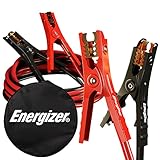
- ENERGIZER 16 FEET JUMPER CABLES - 4 Gauge, 16 FT booster battery jumper cables for jump starting a dead or weak battery. Ideal for trucks, SUVs, full-size cars, mid-size cars and small/compact cars
- ENERGIZER 16 FEET JUMPER CABLES - 4 Gauge, 16 FT booster battery jumper cables for jump starting a dead or weak battery. Ideal for trucks, SUVs, full-size cars, mid-size cars and small/compact cars
- CARRYING CASE INCLUDED - Our Energizer jumper cables come with a high-grade travel bag for easy transport and compact storage.
- TANGLE FREE CCA BOOSTER CABLES - 16 Foot length makes it easy to reach from one car battery to another. Copper clad aluminum cables remains flexible even at -40°C.
- THE BRAND NAME YOU CAN TRUST - We are here to power your car battery and truck with our booster jumper cables. We keep you going and going!
Energizer’s 4-gauge, 16-foot cables are among the most reviewed jumper cables on Amazon, with over 35,000 ratings.

- Strong And Safe Clamps: The TOPDC Jumper Cables booster cable has four giant alligator clamps with strong jagged teeth and springs for excellent grip force. The jaws are strong and make connections easy. And the High Peak Jumper Cables has insulating rubber material to prevent electric shock and protect the safety of users. The clamps are engineered with reinforced structure and well-designed jaws that provide a firm, secure grip on both top-post and side-terminal batteries, ensuring long-lasting durability and ease of use.
- 20 Feet Jumper Cables: The TOPDC 20 Feet Jumper Cables has an extremely long usage distance, which is suitable for use with SUVs, full-size cars, mid-size cars, and compact cars. The Jumper Cables adopts insulating material to prevent rust, corrosion so effective insulation. The 20 Feet Jumper Cables are suitable for various car models and are powerful helper in emergency situations. Made from high-quality Copper Clad Aluminum (CCA), the thick-gauge cables offer excellent conductivity and maintain flexibility even in extreme cold, providing reliable performance when you need it most.
- UL-Listed & qualified quality: The TOPDC Jumper Cables surface is made with premium PVC which is resistant to freezing, cracking & folding and won’t tangle. Each jumper clamp has undergone rigorous testing and successfully passed UL certification, which is exhibiting excellent performance under extreme temperature conditions (-40 °F to 140 °F). The thick vinyl coating is built to resist wear, prevent tearing, and protect the internal wire from exposure, enhancing safety and durability over time.
- Convenient storage and carrying: The TOPDC Jumper Cables will give a Carry Bag. When you need to use Jumper Cables, you can always carry it in your bag. When you don't need to use Jumper Cables, you can pack it in a bag and store it in any place. Convenient storage and carrying are truly essential items at home. The included 600D Oxford fabric storage bag is tough, spacious, and features a smooth zipper for easy access—perfect for neatly organizing cables and accessories without the hassle.
- Quality Assurance: TOPDC provides a 5-year quality guarantee and full after-sales support, reflecting our commitment to excellence and customer satisfaction. Every product undergoes strict quality inspection to ensure superior performance, consistent reliability, and long-lasting durability. The included clearly labeled step-by-step guide makes operation simple even for first-time users. With robust design, dependable construction, and a focus on user experience, TOPDC jumper cables are built to deliver confidence in any emergency situation—whether at home, on the road, or in extreme weather conditions.
TOPDC’s 4-gauge, 20-foot set gives extra reach for awkward parking spots.
Frequently Asked Questions
What order do you connect jumper cables?
Red to dead positive, red to good positive, black to good negative, then black to bare metal on the dead car.
How long should you leave jumper cables on before starting?
Start the donor car and let it run a few minutes before cranking the dead car, especially if the battery is very flat.
Can you connect black to the negative terminal of the dead battery?
Many guides recommend a ground point away from the battery to keep sparks away. Follow your owner’s manual.
What gauge jumper cables do I need?
4 to 6 gauge for most cars and SUVs. Large trucks benefit from 2 to 4 gauge.
Can jumper cables damage my car?
Reversing the clamps or letting them touch can damage electronics. Follow the correct order carefully.
The Bottom Line
To use jump cables, connect red to both positives, black to the good battery’s negative, and the last black clamp to bare metal on the dead car. Start the donor car, then the dead car, remove the cables in reverse order, and drive for at least 20 minutes.






One Comment