What Is Wireless Charging? Qi, Qi2 and MagSafe Explained Simply
JupiterVehicles is reader-supported. As an Amazon Associate, we earn from qualifying purchases.
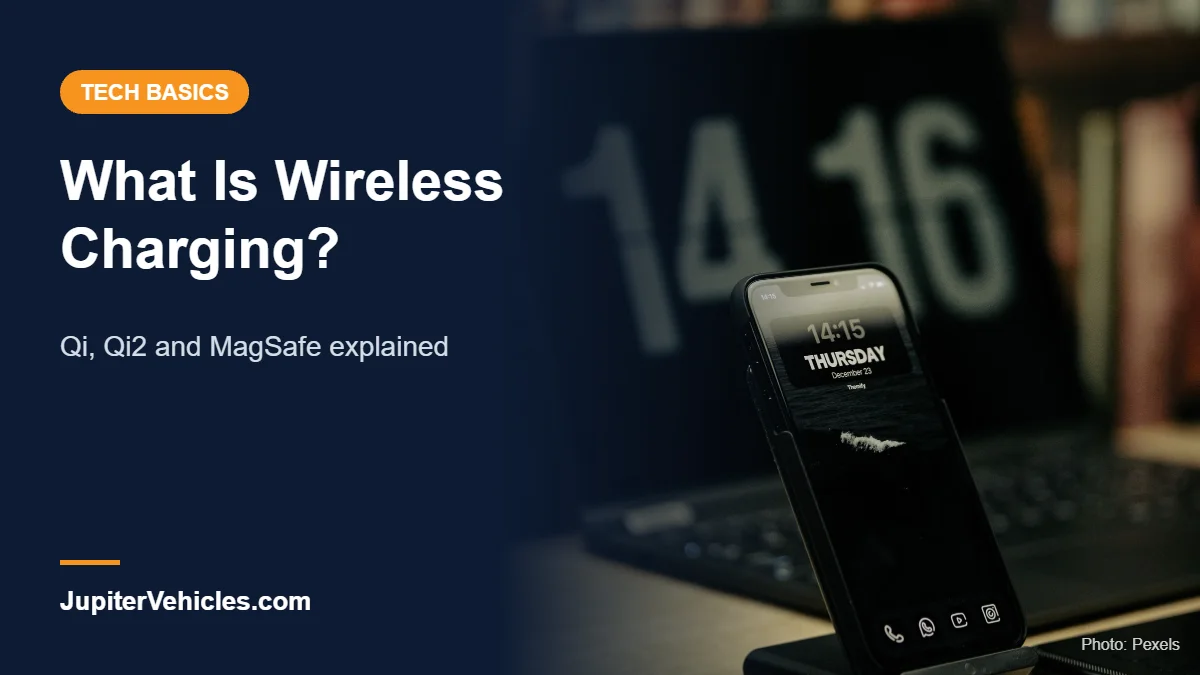
Wireless charging is a way to charge a phone, earbuds or watch by placing it on a charging pad, stand or car mount instead of plugging in a cable. The charger is still plugged into power. The “wireless” part is the short gap between the charger and your device.
Table of Contents
The Short Definition
Wireless charging transfers power from a charger to a device without a cable connecting them. Apple explains that wireless charging uses magnetic induction to charge iPhone. You place the phone on the charger, and it begins charging after a few seconds.
The Main Standards
| Standard | Who’s behind it | Key feature |
|---|---|---|
| Qi | Wireless Power Consortium (WPC) | The universal standard used by most phones |
| Qi2 | Wireless Power Consortium | Adds magnetic alignment for faster, easier charging |
| Qi2 25W | Wireless Power Consortium | Faster Qi2 charging for supported phones |
| MagSafe | Apple | Apple’s magnetic charging system for iPhone 12 and later (most models) |
Apple describes Qi as an open, universal charging standard created by the WPC. The Wireless Power Consortium says Qi2 devices feature magnetic attachment technology that aligns devices and chargers for better energy efficiency, faster charging and easier use.
Which Devices Support Wireless Charging?
- iPhone: iPhone 8 and later, according to Apple.
- Android: many mid-range and flagship phones support Qi, and some support Qi2. Check your phone’s specs.
- Earbuds and watches: many wireless earbuds cases and smartwatches charge wirelessly, though some watches use their own chargers.
Types of Wireless Chargers
- Pads: lie flat on a desk or nightstand.
- Stands: hold the phone upright so you can see the screen.
- Multi-device stations: charge a phone, watch and earbuds together.
- Car chargers: mounts that hold and charge a phone while you drive. See our car wireless charger picks.
- Magnetic power banks: battery packs that snap onto the back of a phone.
Pros and Cons
| Pros | Cons |
|---|---|
| No cable wear on the phone’s port | Usually slower than a fast cable |
| Drop the phone on and go | Phone must be aligned (less of an issue with Qi2) |
| Works in cars, cafes and hotels | Generates more heat |
| Magnetic versions double as mounts | Thick or metal cases can block it |
Is Wireless Charging Safe?
Certified chargers are designed for safe use. Apple advises not placing items like credit cards, security badges, passports or key fobs between the iPhone and charger, since they can be damaged, and notes iPhone may limit charging above 80 percent if it gets too warm.
Frequently Asked Questions
Is wireless charging the same as MagSafe?
MagSafe is Apple’s magnetic version of wireless charging. Qi and Qi2 are the industry standards.
Does wireless charging work through a case?
Usually through thin cases. Thick, metal or wallet cases can block or slow it.
Is wireless charging slower than wired?
Often, yes. Apple says many Qi-certified chargers charge iPhone at up to 7.5 watts, while Qi2 and MagSafe chargers can be faster.
Does my phone support wireless charging?
iPhone 8 and later do. For Android, check your phone’s specifications for Qi or Qi2.
The Bottom Line
Wireless charging lets you charge a phone by setting it on a pad, stand or mount instead of plugging it in. Qi is the universal standard, Qi2 adds magnetic alignment and faster speeds, and MagSafe is Apple’s magnetic system for most iPhone 12 and later models.