How Does a Car Battery Charge? The Chemistry and Charging Stages Explained
JupiterVehicles is reader-supported. As an Amazon Associate, we earn from qualifying purchases.
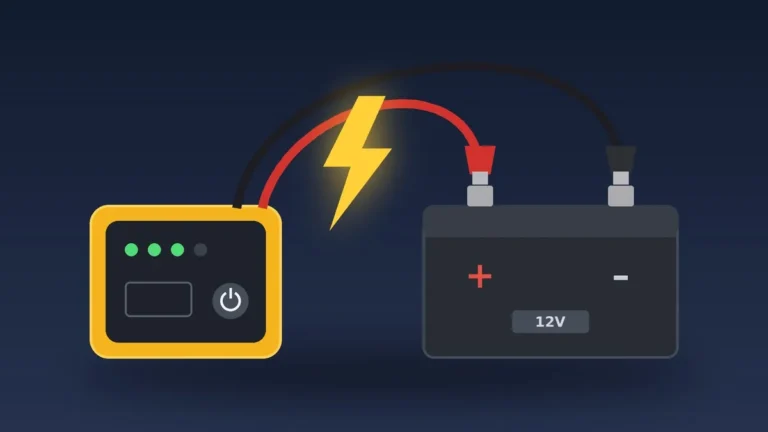
A car battery stores energy chemically. When you start the car, a chemical reaction releases that energy as electricity. Charging pushes current back into the battery to reverse the reaction, so it’s ready for the next start. Here’s what happens inside, in plain terms.
Table of Contents
What’s Inside a 12V Car Battery
Most car batteries are lead-acid. Inside are six cells, each producing about 2 volts, connected in series for roughly 12 volts. Each cell has positive plates (lead dioxide), negative plates (spongy lead) and an electrolyte of sulfuric acid and water. AGM batteries use the same chemistry, with the electrolyte held in glass mats.
What Happens When the Battery Discharges
When you start the car or run accessories with the engine off:
- The lead and lead dioxide plates react with the sulfuric acid
- Both plates gradually become coated with lead sulfate
- The electrolyte becomes weaker (more water, less acid)
- Electricity flows out to the starter and electronics
What Happens When It Charges
Charging forces current into the battery in the opposite direction:
- Lead sulfate on the plates converts back to lead and lead dioxide
- Sulfate returns to the electrolyte as sulfuric acid
- The battery’s voltage and stored energy rise
The current comes from the alternator while driving or from a plug-in charger. Learn about those sources in what charges a car battery.
The Three Charging Stages
Battery University explains that lead-acid batteries charge in three stages:
- Constant-current (bulk): the charger supplies its full rated current. This stage does most of the work and takes roughly half the total time.
- Topping charge: the voltage holds steady while the current tapers off, saturating the battery.
- Float charge: a lower voltage offsets natural self-discharge and keeps the battery full.
Battery University puts a typical full charge at 12 to 16 hours. Smart chargers move through these stages automatically.
Why Charging Slows Down Near Full
As the plates convert back, there’s less lead sulfate left to react, so the battery accepts current more slowly. Pushing harder at that point creates heat and gas instead of stored energy, which is why good chargers taper the current.
What Stops a Battery From Charging Fully
- Sulfation: Battery University says sulfation occurs when a lead-acid battery is deprived of a full charge. Hardened sulfate crystals don’t convert back easily.
- Cold temperatures: chemical reactions slow down in the cold.
- Age and wear: plates shed material over years of use.
- Short trips: the alternator may not have time to finish the job.
How to Help Your Battery Charge Properly
- Use a smart charger with the correct battery-type setting
- Keep the battery full during storage with a maintainer
- Clean corroded terminals so current flows freely
- Have the battery tested if it won’t hold a charge

- MEET THE GENIUS10 — Similar to our G7200, just better. It's 17% smaller and delivers over 115% more power. It's the all-in-one charging solution - battery charger, battery maintainer, trickle charger, plus desulfator.
- DO MORE WITH GENIUS — Designed for 6-volt and 12-volt lead-acid (AGM, Gel, SLA, VRLA) and lithium-ion (LiFePO4) batteries, including flooded, maintenance-free, deep-cycle, marine and powersport batteries.
- ENJOY PRECISION CHARGING — An integrated thermal sensor dynamically adjusts the charge based on ambient temperature, preventing overcharging in hot weather and undercharging in cold, ensuring optimal battery performance.
- CHARGE DEAD BATTERIES — Charge batteries from as low as 1 volt, or use Force Mode to manually charge completely dead batteries down to zero volts. Perfect for recovering deeply discharged or neglected batteries.
- BEYOND MAINTENANCE — Keep your battery fully charged without worrying about overcharging. Our smart charger constantly monitors the battery, allowing you to leave it connected safely - indefinitely - for worry-free maintenance.

Frequently Asked Questions
How does a car battery recharge while driving?
The alternator generates electricity when the engine runs and sends extra current to the battery, reversing the discharge reaction.
Why does my battery die even though I drive?
Short trips, heavy electrical loads, parasitic drain or an aging battery can leave it undercharged.
Can an overcharged battery be damaged?
Yes. Overcharging can cause heat and gassing, which loses water and can shorten battery life. Smart chargers prevent this.
How do I know my battery is charging?
A charger’s status lights show it, and while driving, a healthy charging system keeps the battery warning light off.
The Bottom Line
A car battery charges by reversing the chemical reaction that powers the starter, turning lead sulfate back into lead, lead dioxide and sulfuric acid. Chargers do this in bulk, topping and float stages, which is why the last part of a charge always takes longest.