
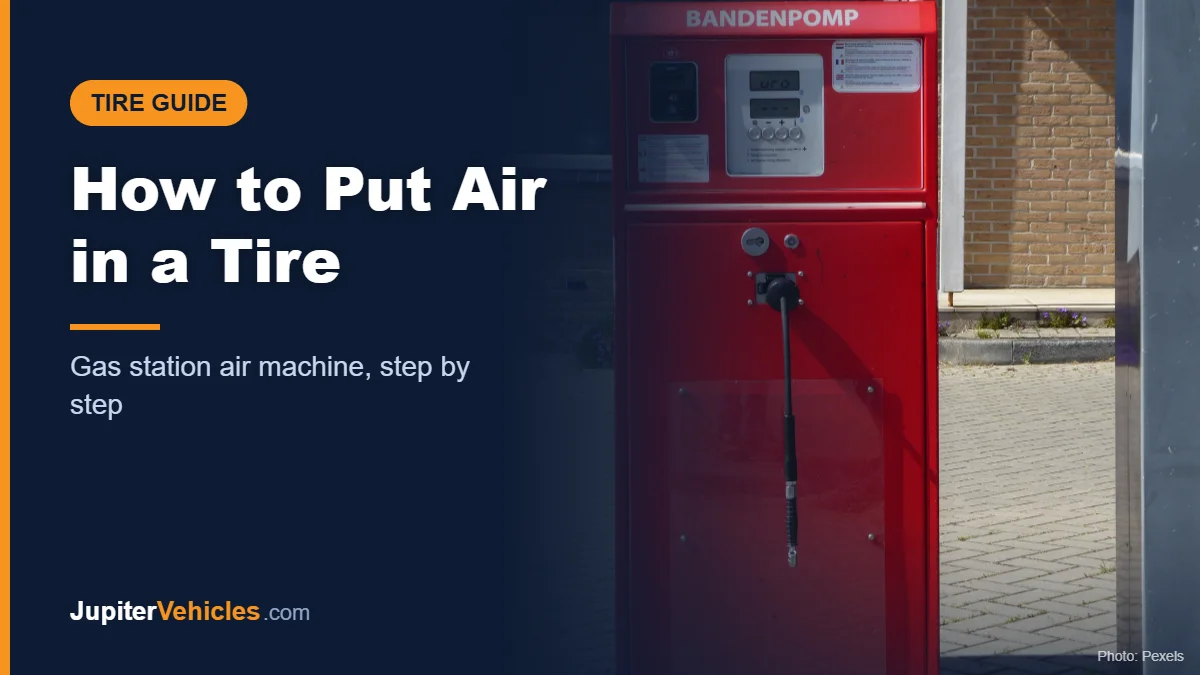
How to Put Air in a Tire at a Gas Station (Step by Step)
To put air in a tire, find your car’s recommended pressure on the label inside the driver’s door, remove the valve cap, press the air hose firmly onto the valve stem, and add air in short bursts. Check the pressure with a gauge between bursts until you reach the recommended number, then replace the cap. Do the same for every tire, including the spare if your car has one.
Here’s how to do it at a gas station air machine, plus how to avoid the mistakes that lead to over- or underinflated tires.
Table of Contents
Step 1: Find Your Correct Tire Pressure
Your target pressure is on the Tire and Loading Information label, usually on the driver’s door edge or door post, and in your owner’s manual. NHTSA emphasizes that the correct pressure is what the vehicle manufacturer lists, not the maximum pressure printed on the tire sidewall.
Some vehicles list different pressures for the front and rear tires, so check both numbers.
Step 2: Check the Pressure Before You Add Air
Tire pressure should ideally be checked when tires are cold. NHTSA defines “cold” as not driven for at least three hours. If you’ve just driven to the gas station, your tires will read higher than their cold pressure.
That’s fine for a quick top-up. NHTSA notes it’s safer to run a tire slightly under the recommended cold pressure than significantly underinflated, so you can fill to the recommended number now and recheck when the tires are cold.
Use your own gauge if you can. The built-in gauges on gas station machines aren’t always accurate.
Affiliate disclosure: As an Amazon Associate I earn from qualifying purchases.

- Accurate, Dependable Readings: Factory‑calibrated to ±1 PSI, so you can confidently match your vehicle’s recommended PSI (check the door jamb sticker). Ideal for monthly checks and road trips — consistent results every time, cold or warm.
- Bright Backlit Display & Nozzle Light: The illuminated nozzle helps you find the valve stem in the dark, while the backlit LCD makes readings crystal clear in dim garages or at night. No more squinting or holding a flashlight.
- 4 Measurement Units, One Button: Quickly switch among PSI, Bar, Kgf/cm², and KPA with a single press. No complex settings — just press and cycle to your preferred unit. Perfect for drivers who need multiple scales.
- Broad Compatibility for Everyday Vehicles: 0–150 PSI covers cars, SUVs, motorcycles, and spare tires (often 60 PSI). Fits standard Schrader valves; just press on for a reading.
- Auto‑Off to Extend Battery Life: The gauge automatically powers down after 30 seconds of inactivity, so the included 2*AAA batteries last longer. Always ready for your monthly checks without surprise dead batteries.

Step 3: Get the Air Machine Ready
- Park so the hose can reach all four tires. You may need to move the car halfway through.
- Some machines are free; others take coins, cards, or an app. Many run on a timer, so have your caps off before you start.
- If the machine lets you set a target pressure, enter your number. It will add air and beep when it reaches it.
Step 4: Add Air to Each Tire
- Remove the valve cap and put it somewhere you won’t lose it.
- Press the hose nozzle straight and firmly onto the valve stem. A hissing sound means it isn’t sealed. Push harder or adjust the angle.
- Add air in short bursts of a few seconds.
- Check the pressure with your gauge.
- Repeat until you reach the recommended pressure.
- Replace the valve cap. It keeps dirt and moisture out of the valve.
Step 5: If You Overfill a Tire
Press the small pin in the center of the valve stem with the tip of your gauge (many gauges have a nub for this) to let air out in short bursts. NHTSA describes this same method for releasing excess pressure. Recheck until you reach the target.
Step 6: Recheck Later
Check the tires again the next morning when they’re cold. If one tire keeps losing pressure, it may have a puncture or a leaking valve. Our guide on how to plug a tire explains what can and can’t be repaired.
Common Mistakes When Putting Air in Tires
| Mistake | Why it matters | Fix |
|---|---|---|
| Inflating to the number on the tire sidewall | That’s the tire’s maximum, not your car’s recommended pressure | Use the door placard number |
| Trusting the gas station gauge | Built-in gauges can be off | Carry your own gauge |
| Forgetting the spare | A flat spare doesn’t help in an emergency | Check it when you check the others |
| Leaving off the valve cap | Dirt can get into the valve | Replace every cap |
| Only filling the low tire | Uneven pressures can affect handling | Check and set all four |
Skip the Gas Station: Inflate at Home
A portable tire inflator lets you top up your tires in your driveway, often with a preset pressure and auto shut-off. See our guide to the best tire inflator for 12 options.
Frequently Asked Questions
How do I know if my tire needs air?
Check it with a gauge. Many cars also have a tire pressure monitoring system (TPMS) warning light. If the light comes on, check all tires with a gauge.
How much does it cost to put air in tires?
Some gas stations offer free air, while others charge a small fee. Prices and policies vary by location.
Can I put air in my tires when they’re hot?
Yes, especially if they’re low. Fill to the recommended pressure, then recheck when the tires have cooled.
How often should I check my tire pressure?
A common recommendation is at least once a month and before long trips. Tires lose some pressure naturally over time and with temperature changes.
The Takeaway
Putting air in a tire takes a few minutes: find the door placard pressure, add air in short bursts, check with your own gauge, and replace the caps. Doing it regularly helps your tires wear evenly and keeps your car handling the way it should.
For more detail on checking pressure, see how to check tire pressure.
One Comment