
What Is a Jump Box? Heavy-Duty Jump Packs Explained
JupiterVehicles is reader-supported. As an Amazon Associate, we earn from qualifying purchases.
A jump box is a portable battery booster used to start vehicles with dead batteries. The term usually brings to mind the heavy, shop-style units you see in garages and on tow trucks: a big sealed lead-acid battery in a rugged case with thick cables and heavy clamps. Many sellers also use “jump box” for compact lithium jump starters, so the word covers both.
This guide focuses on what makes a jump box different from a glovebox-sized jump pack, what’s inside one, and who should actually own one.
Table of Contents
Jump Box Meaning
In everyday use, “jump box,” “jump pack,” “booster pack,” and “jump starter” mean roughly the same thing: a self-contained battery that can jump-start a car without a second vehicle.
In the auto trade, though, a jump box usually means a heavy-duty portable booster built for repeated daily use. Consumer Reports’ jump-starter guide describes these traditional lead-acid booster packs as great for car dealers and auto recovery services, but too bulky for most drivers’ emergency kits.
What’s Inside a Jump Box
A typical lead-acid jump box includes:
- A sealed lead-acid battery: often an AGM-style battery designed for high bursts of current. Clore’s Jump-N-Carry JNC660, for example, uses a 22Ah battery.
- Heavy-gauge cables: thick copper cables, such as #2 AWG, carry high current with less voltage drop. Longer cables let you reach batteries without moving the box.
- Heavy-duty clamps: large clamps that bite onto terminals and posts.
- A charge indicator or voltmeter: shows whether the internal battery is ready.
- A charging input: either a built-in charger with a wall cord or an external charger.
- Accessory outlets: many have a 12V socket to power accessories or tools.
How a Jump Box Works
A jump box works like a donor car without the car. Its internal 12-volt battery connects in parallel with your car’s weak battery through the clamps. When you crank the engine, the box supplies most of the current the starter motor needs. Once the engine runs, you disconnect it and let the alternator recharge the car’s battery.
For the step-by-step process, see how to use a portable jump starter. The basic order is the same for a jump box.
Jump Box vs. Lithium Jump Starter
| Feature | Lead-acid jump box | Compact lithium jump starter |
|---|---|---|
| Weight | Heavy, often 15 to 25+ lb | Light, often 1 to 3 lb |
| Size | Toolbox-sized | Fits in a glovebox |
| Cables | Long, thick cables | Short cables |
| Repeated jumps | Built for many jumps per day | Several jumps per charge |
| Charge holding | Needs regular charging | Holds charge for months |
| Extras | 12V outlet, sometimes an air compressor | USB charging, flashlight |
| Typical buyer | Shops, tow operators, fleets | Everyday drivers |
Who Needs a Real Jump Box?
- Repair shops and dealerships that move cars with weak batteries every day
- Tow and roadside operators who jump many vehicles in a shift
- Fleet managers with vans, trucks and equipment
- Farm and heavy-equipment owners with large engines
- Car collectors whose vehicles sit for long periods
For one family car, a compact lithium pack is easier to store and carry. See our list of the best rated battery jump starters for both types.
Popular Jump Box Examples
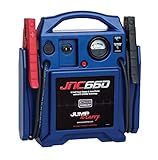
- 22Ah Clore Proformer Battery designed for Jump Starting
- 46" Heavy-Duty #2 AWG Cables
- Voltmeter provides charge status of on board battery
- 1700 Peak Amps
- DC outlet to power 12V accessories

The Clore Jump-N-Carry JNC660 is a classic shop jump box: 1,700 peak amps, a 22Ah battery, 46-inch #2 AWG cables, and a built-in voltmeter.

- 1,700 Peak Amps; 425 Cranking Amps
- Clore PROFORMER Battery Technology
- 68" 2 AWG Welding Cable Leads
- Heavy Duty Powerjaw Clamps
- Built-in 3A Automatic Charger
The JNC770R lists 1,700 peak amps and 425 cranking amps, 68-inch welding cable leads, and a built-in 3A automatic charger for easier upkeep.
How to Maintain a Jump Box
Lead-acid jump boxes last longest when you keep them charged:
- Recharge after every use, even after a single jump.
- Top it up regularly when it sits unused. Check the voltmeter or charge light every few weeks.
- Never store it discharged. Battery University explains that sulfation occurs when a lead-acid battery is deprived of a full charge, which shortens its life.
- Store it in moderate temperatures, away from direct sun and freezing conditions when possible.
- Inspect the cables and clamps for cracked insulation, corrosion or loose connections.
Frequently Asked Questions
Is a jump box the same as a jump starter?
In everyday use, yes. Both are portable batteries that jump-start vehicles. In shops, “jump box” usually means a heavier lead-acid unit built for frequent use.
How long does a jump box last?
With regular charging, a good lead-acid jump box can last several years. Leaving it discharged is the fastest way to shorten its life, and many models let you replace the internal battery.
Can I leave a jump box on the charger?
Only if the charger is automatic or designed for maintenance charging. Check the manual, since some older chargers can overcharge.
Is a jump box better than jumper cables?
For convenience, yes, because you don’t need a second car. Jumper cables are cheaper and never need charging.
Can a jump box start a diesel truck?
Many can, but check the box’s rating. Large diesels need more power, and heavy-duty boxes with long, thick cables are common for trucks.
The Bottom Line
A jump box is a portable battery booster for jump-starting vehicles. The classic version is a heavy lead-acid unit with thick cables that shops and tow operators rely on for daily use. Everyday drivers are usually better served by a compact lithium jump starter, but if you jump cars often or work on big engines, a real jump box is worth the extra weight.




One Comment