How to Read Tire Pressure: Gauges, Dashboard Displays, and Units
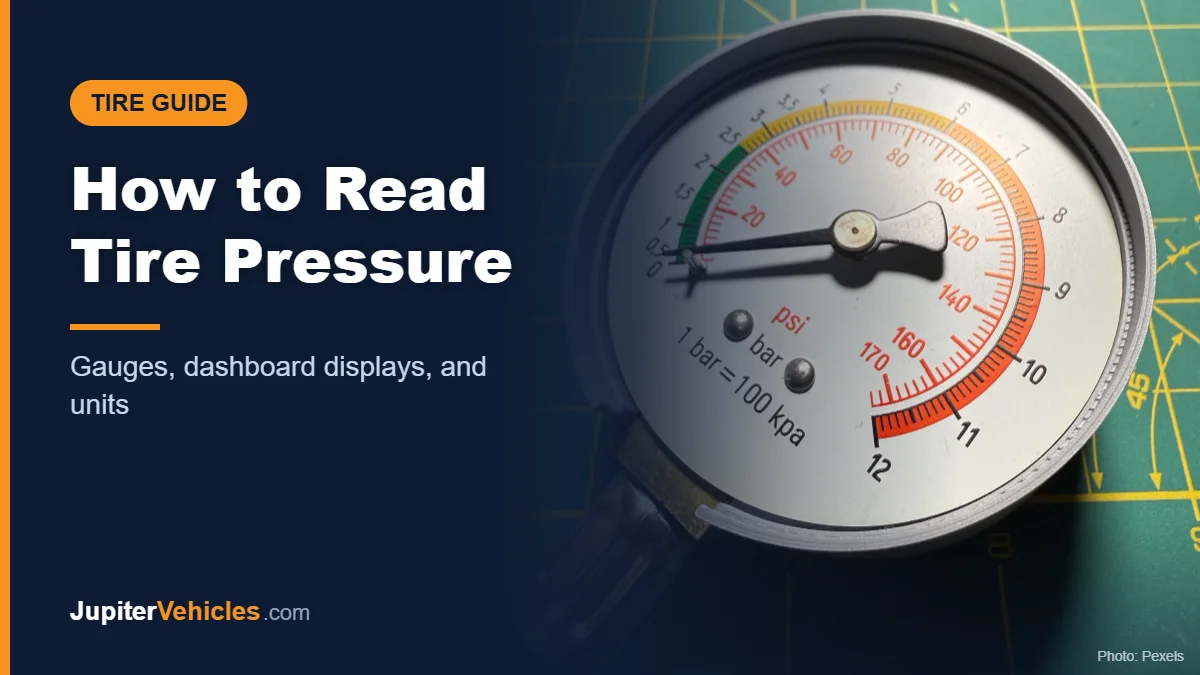
To read tire pressure, press a tire gauge firmly onto the valve stem and read the number on the display, dial, or sliding scale. That’s the pressure in PSI (pounds per square inch), or sometimes bar or kPa. Then compare it with the recommended cold pressure on your driver’s door label. If your car has a tire pressure display on the dashboard, it shows the same kind of reading for each tire, though a hand gauge is usually the better way to confirm it.
Here’s how to read each type of gauge, your car’s display, and the markings on the tire itself.
Table of Contents
Before You Read: Take the Measurement Cold
A tire pressure reading only makes sense when you compare it with the right number at the right time. NHTSA says recommended pressures apply to cold tires, meaning not driven for at least three hours. A reading right after a drive will be higher.
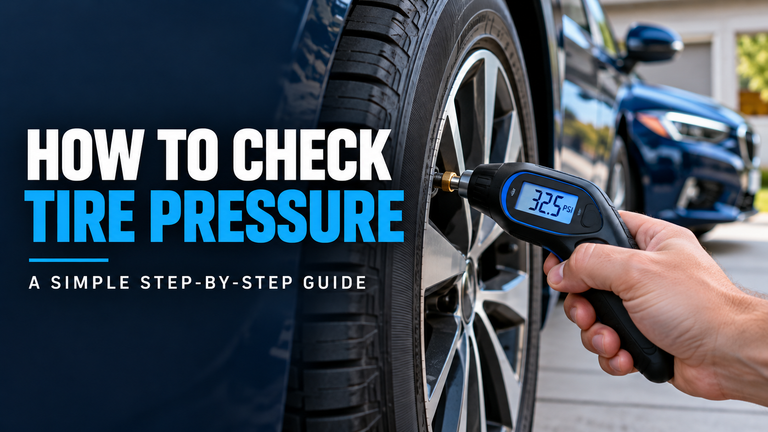
How to Read a Digital Tire Gauge
- Turn the gauge on, if it has a button.
- Remove the valve cap and press the gauge straight onto the valve stem until the hissing stops.
- Read the number on the screen. Many gauges hold the reading after you remove them.
- Check the unit shown (PSI, BAR, or kPa). Most digital gauges let you switch units.
Digital gauges are the easiest to read because there’s no scale to interpret.
Affiliate disclosure: As an Amazon Associate I earn from qualifying purchases.

- Accurate, Dependable Readings: Factory‑calibrated to ±1 PSI, so you can confidently match your vehicle’s recommended PSI (check the door jamb sticker). Ideal for monthly checks and road trips — consistent results every time, cold or warm.
- Bright Backlit Display & Nozzle Light: The illuminated nozzle helps you find the valve stem in the dark, while the backlit LCD makes readings crystal clear in dim garages or at night. No more squinting or holding a flashlight.
- 4 Measurement Units, One Button: Quickly switch among PSI, Bar, Kgf/cm², and KPA with a single press. No complex settings — just press and cycle to your preferred unit. Perfect for drivers who need multiple scales.
- Broad Compatibility for Everyday Vehicles: 0–150 PSI covers cars, SUVs, motorcycles, and spare tires (often 60 PSI). Fits standard Schrader valves; just press on for a reading.
- Auto‑Off to Extend Battery Life: The gauge automatically powers down after 30 seconds of inactivity, so the included 2*AAA batteries last longer. Always ready for your monthly checks without surprise dead batteries.

How to Read a Dial Tire Gauge
- Press the chuck firmly onto the valve stem.
- Read where the needle points on the dial. Many dial gauges show PSI on one scale and bar or kPa on another, so read the scale labeled PSI.
- If the gauge has a hold function, the needle stays in place until you press the release button.
Read the dial straight on, not at an angle, to avoid misreading the needle.
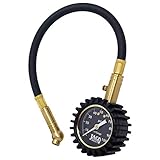
- Mechanic Recommended - performance tested, certified, & calibrated accurate within ANSI Standards (±1.5%) at our ANSI accredited calibration facility, ensuring precise tire pressure readings without relying on batteries
- Feels rugged in the hand & built to last from solid brass shielded by our durable shock-resistant gear-style protective guard; features our signature HybridFlex leak-proof air hose providing a soft feel with superior strength & flexibility
- Robust design is equipped with a built-in air bleeder valve to reduce pressure in overinflated tires, and the handy 360-degree swivel chuck allows for easy access to the tire valve from any angle
- Larger, 2" glow dial features easy-to-read 100 PSI single increment scale that glows in the dark, providing accurate readings that "lock" in place until the pressure reset button on the brass neck is pressed
- 100% Lifetime Warranty by JACO when you order today, so click buy with confidence and enjoy longer-lasting tires, improved gas mileage, and a smoother car driving experience with the help of properly inflated tires.
How to Read a Pencil (Stick) Tire Gauge
- Press the gauge onto the valve stem. A small bar slides out of the end.
- Remove the gauge and read the number where the bar meets the gauge body.
- Read it at eye level, as small markings can be easy to misread.
Pencil gauges are small and cheap, which makes them a good glovebox backup. For more options, see our guide to the best tire pressure gauge.
How to Read Your Dashboard Tire Pressure Display
Many newer cars show each tire’s pressure in the instrument cluster or infotainment screen.
- Numbers next to each tire: the current pressure of each tire, usually in PSI.
- A tire-shaped warning light: at least one tire is low. Under the U.S. TPMS rule, the warning relates to a tire being 25% below the cold placard pressure, according to an NHTSA interpretation.
- A flashing light: on many cars, this signals a TPMS system fault rather than low pressure. Check your owner’s manual.
Some cars only show a warning light and don’t display individual pressures. In that case, use a hand gauge on each tire.
How to Read the Tire Sidewall
The sidewall shows a maximum pressure, often written like “MAX. PRESS. 300 kPa (44 PSI)”. That’s the most the tire can safely hold. It isn’t your target pressure. Your correct pressure is the vehicle manufacturer’s figure on the door label, as explained in what should my tire pressure be.
PSI, Bar, and kPa: Converting Units
| Unit | Conversion |
|---|---|
| 1 bar | About 14.5 PSI |
| 1 PSI | About 6.9 kPa |
| 100 kPa | About 14.5 PSI (1 bar) |
| 35 PSI | About 2.4 bar or 241 kPa |
| 32 PSI | About 2.2 bar or 221 kPa |
If your door label and gauge use different units, convert before comparing, or switch your digital gauge to match.
What Your Reading Means
| Reading compared with door label | What to do |
|---|---|
| Matches (cold) | Nothing. Replace the valve cap |
| Lower | Add air until it matches |
| Higher (cold) | Release air in short bursts |
| Higher right after driving | Wait for the tires to cool and recheck |
Need to add air? See how to inflate car tires or how to put air in a tire.
Frequently Asked Questions
Why do I get a different reading each time?
Press the gauge on straight and firmly. A partial seal lets air escape and gives a low or inconsistent reading. Take two readings and use the consistent one.
Is the dashboard tire pressure reading accurate?
It’s useful for spotting changes, but readings can differ slightly from a hand gauge. Use a good gauge to confirm.
What does “PSI” stand for?
Pounds per square inch, the standard unit for tire pressure in the U.S.
Should I read the pressure on the spare too?
Yes. A spare that’s low or flat won’t help when you need it.
The Takeaway
Reading tire pressure is simple once you know the gauge type and the units. Measure cold, read the number carefully, convert if needed, and compare it with the recommended pressure on your door label, not the maximum on the tire.