How Much PSI for a Car Tire? A Practical Guide for Every Situation
Put in the PSI listed on your car’s tire and loading information label (on the driver’s door edge or door post), measured when the tires are cold. Many passenger cars land somewhere in the low-to-mid 30s, but your exact number depends on your vehicle and tire size. Never inflate to the maximum PSI printed on the tire sidewall. That’s a limit, not a target.
Below is how to work out how much air to add, and how the right PSI applies in different situations.
Table of Contents
Step 1: Find Your Target PSI
Your target is the vehicle manufacturer’s cold pressure on the door label or in the owner’s manual. NHTSA points drivers to this label and stresses that the tire sidewall number is not the correct pressure. If your car lists different front and rear numbers, use each one for its axle.
Need help finding it? See what should my tire pressure be.
Step 2: Work Out How Much Air to Add
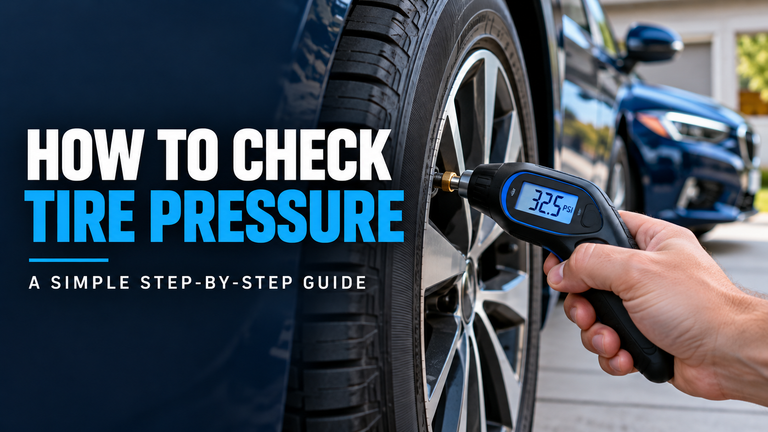
NHTSA suggests a simple method: measure each tire, note the difference from the recommended pressure, and add those “missing” pounds.
| Door label | Your cold reading | Add |
|---|---|---|
| 35 PSI | 31 PSI | About 4 PSI |
| 33 PSI | 30 PSI | About 3 PSI |
| 36 PSI | 38 PSI | Release about 2 PSI |
If the tires are warm from driving, the reading will be higher than the cold value. Fill to the label figure anyway if they’re low, then recheck when they’re cold.
How Much PSI in Different Situations
Everyday driving
Use the door-label figure. It’s set for your vehicle’s normal use.
Heavy loads, passengers, or towing
Some owner’s manuals list a higher pressure for maximum load or towing. If yours does, use it when fully loaded and go back to the standard figure afterward. Never exceed the tire’s maximum sidewall pressure.
Winter
The target doesn’t change, but the actual pressure does. Bridgestone says pressure changes by about 1 psi for every 10°F change in temperature. A 30-degree drop can cost about 3 psi, so check and top up more often in cold months.
Long highway trips
Check before you leave, with the tires cold, and follow any higher-speed or full-load guidance in your owner’s manual.
The spare tire
Compact temporary spares often need a much higher pressure than your regular tires. Check the spare figure on the door label or in the manual, and check it whenever you check the others.
After changing tire size
If your tires aren’t the size on the door label, the label pressure may not apply. Ask a tire professional for the correct figure.
What Happens at the Wrong PSI
| Pressure | What can happen |
|---|---|
| Too low | More heat buildup, faster wear on the outer edges, less precise handling, worse fuel economy |
| Too high | Smaller contact patch, faster center wear, harsher ride, possibly reduced grip |
| At the label figure | Even wear and the handling and braking the vehicle was designed for |
Don’t wait for the TPMS light to tell you something’s wrong. Under the U.S. TPMS standard, it relates to a tire being about 25% below the recommended pressure, so the tire is already well underinflated by the time it comes on.
Adding the Right Amount of Air
A portable inflator with a preset target makes this easy: set your door-label PSI and it stops automatically.
Affiliate disclosure: As an Amazon Associate I earn from qualifying purchases.

- Anti-Slip & Shock-Resistant Silicone Protection: This silicone sleeve shields the tire inflator fromdrops, bumps and scratches while improving grip and reducing noise and vibration. It also boosts durability, portability, and safety to deliver a better user experience.Suitable as a Father's Day gift for your dad.
- COMPACT, FASTER INFLATION: Weighing only 1.01 pound(5.31*2.71*2.04 IN), this portable tire inflator is easy to carry and store in any limited space, such as cars, bike racks, or backpacks. It's suitable as a car accessories gift for men or women. The compressor's 150PSI maximum pressure, it can refill a 195/65R15 tire from 30 to 36PSI in just 1.5 minutes.(Note: Incompatible with heavy-duty tires. )
- EASY TO USE: You can choose 5 smart modes (car, motorcycle, bicycle, ball, and custom) and 4 pressure units as needed (PSI, Bar, kPa, kg/cm²) based on your various inflation needs. The custom mode allows you to freely preset the desired pressure value (3-150PSI) based on the inflatables you want to inflate. The exterior silicone sleeve protects against accidental drops, prolonging the tool’s service life.
- LONG RUNTIME & AUTO-OFF: After fully charging, the built-in 4000mAh large-capacity battery allows the air compressor to refill up to 8 tires (195/65R15) from 30-36PSI. The preset function and auto-off function deliver a hands-free inflation experience. With just one press, the portable tire inflator will easily inflate car tires, motorcycle tires, bicycle tires, balls, and more. (Note: Incompatible with heavy-duty tires, like those on offroad vehicles, RVs, trucks, and trailers.)
- ALL IN ONE TOOL: The air compressor can be used as more than an air pump, it is also a multifunctional emergency tool. The flashlight on the top has 3 modes (flashlight, SOS, and strobe) to illuminate the night for easy operation. Equipped with USB-C and USB input/output ports, this air compressor provides backup power for your phones and other electronic devices.
See our guides to the best tire inflator and how to inflate car tires for more. To understand your readings, see what is normal tire pressure.
Frequently Asked Questions
Is 32 PSI good for car tires?
It’s a common recommendation for many passenger cars, but check your door label. Your vehicle may specify a different number.
Can I put 40 PSI in my car tires?
Only if your door label or owner’s manual specifies it, for example for heavy loads. Otherwise, use the recommended figure.
Should I put more air in my tires in winter?
Inflate to the same recommended figure, but check more often. Cold weather lowers tire pressure.
How much PSI should a spare tire have?
Compact spares often need higher pressure than regular tires. Check the spare pressure on the door label or in the owner’s manual.
The Takeaway
The right PSI for a car tire is the cold pressure on your door label. Measure, add the difference, and adjust only when your owner’s manual says to, such as for heavy loads. Check monthly and more often in cold weather.