What Is a Jump Starter? How It Works, Types, and When You Need One
JupiterVehicles is reader-supported. As an Amazon Associate, we earn from qualifying purchases.
A jump starter is a portable battery pack with built-in clamps that can start a car with a dead 12-volt battery. You connect it to the battery, turn it on, and start the engine, no second car or jumper cables needed.
This guide explains what a jump starter is, how it works, the different types, and how it compares with jumper cables and battery chargers.
Table of Contents
Jump Starter: The Simple Definition
A jump starter (also called a jump pack, booster pack, or battery booster) stores electrical energy in its own battery. When your car battery is too weak to turn the starter motor, the jump starter supplies a short, powerful burst of current through its clamps so the engine can crank and start.
Once the engine runs, the car’s alternator takes over and starts recharging the car battery. The jump starter’s job is done.
How a Jump Starter Works
- Stored energy: a lithium-ion or lead-acid battery inside the pack holds the charge.
- Clamps and cables: short cables with red (positive) and black (negative) clamps connect the pack to your car battery.
- Smart circuitry: most modern packs check the connection first. If the clamps are reversed or touching, the pack won’t send power.
- The burst: when you crank the engine, the pack delivers high current for a few seconds, measured in amps.
- Disconnect: after the engine starts, you remove the clamps and the alternator does the rest.
Consumer Reports’ jump-starter buying guide describes peak amps as the maximum power a pack can deliver over a burst lasting a few seconds, and notes that bigger and diesel engines need more.
Types of Jump Starters
| Type | Battery inside | Typical size | Best for |
|---|---|---|---|
| Compact lithium jump starter | Lithium-ion | Paperback-book size, 1 to 3 lb | Glovebox emergency use for most drivers |
| Lithium jump starter with air compressor | Lithium-ion | Larger, lunchbox size | One tool for dead batteries and low tires |
| Lead-acid jump box | Sealed lead-acid (AGM) | Large, often 15 to 25+ lb | Shops, tow trucks, frequent use |
| Capacitor-based (ultracapacitor) jump starter | Supercapacitors | Varies | Fast recharge, wide temperature range |
Most drivers today buy a compact lithium pack. Consumer Reports notes that today’s mini jump starters weigh only 1 or 2 pounds and are roughly the size of a paperback novel, while older lead-acid booster packs were much bulkier. The heavier boxes are still common in shops. We explain them in what is a jump box.
What Comes With a Jump Starter
Most packs include:
- The battery pack with a charge level indicator
- A clamp cable (often a smart cable with status lights)
- A USB or USB-C charging cable
- A built-in LED flashlight with steady, SOS and strobe modes
- USB ports to charge phones, so it doubles as a power bank
- A storage case
Jump Starter vs. Jumper Cables vs. Battery Charger
| Tool | Needs another car? | Starts a dead car? | Recharges the battery? |
|---|---|---|---|
| Jump starter | No | Yes, in minutes | No (only a short boost) |
| Jumper cables | Yes | Yes, with a donor car | No |
| Battery charger | No (needs a wall outlet) | Not usually, it takes hours | Yes |
| Battery maintainer | No (needs a wall outlet) | No | Keeps a battery topped up |
A jump starter is the most convenient for roadside emergencies. A charger is better for restoring a deeply discharged battery at home.
Safety Features to Look For
- Reverse-polarity protection: stops power if the clamps are on the wrong terminals.
- Spark-proof clamps: no sparks if the clamps touch.
- Short-circuit and over-current protection.
- Overheat protection.
- Boost or override mode: lets you jump a battery so dead the pack can’t detect it. Use it carefully, because it bypasses some protections.
Can You Use a Jump Starter on Any Vehicle?
Jump starters work on most 12-volt vehicles: cars, SUVs, pickups, motorcycles, ATVs and boats, as long as the pack is rated for the engine size. Hybrids and electric vehicles also use a 12-volt battery for their electronics, and that battery can sometimes be jumped. Consumer Reports warns never to use a jump starter on the high-voltage drive battery of an EV, plug-in hybrid or hybrid, and to follow the owner’s manual.
Do You Need a Jump Starter?
A jump starter is worth having if you:
- Drive an older car or a car with an aging battery
- Live somewhere cold, where batteries fail more often
- Drive alone, at night, or in remote areas
- Leave a car parked for weeks at a time
- Don’t want to rely on strangers or roadside assistance
It’s one of the accessories we list in what car accessories are worth buying. For specific models, see our list of the best rated battery jump starters.
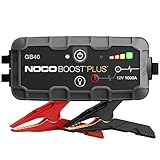
- START DEAD BATTERIES — Instantly start dead batteries with 1000 amps of peak lithium power. Up to 20 starts per charge on engines up to 6.0L gas and 3.0L diesel.
- ULTRASAFE TECHNOLOGY — Engineered with patented spark-proof and reverse polarity protection for foolproof connections to any 12V vehicle - no sparks, no wrong connections.
- PORTABLE POWER BANK — Integrated power bank delivers emergency power to smartphones, tablets, and more. Recharges in 3 hours so it’s ready when it matters most.
- INTEGRATED LED FLASHLIGHT — Precision-engineered 100-lumen LED with 7 light modes, including SOS and strobe. Illuminate repairs, emergencies, or low-light environments.
- COMPACT YET POWERFUL — High-discharge lithium technology delivers exceptional starting performance in a compact 2.5 lb form factor - perfectly sized for glove boxes and emergency kits.

Frequently Asked Questions
Is a jump starter the same as a battery charger?
No. A jump starter gives a short burst of power to start the engine. A battery charger slowly restores a battery’s charge over several hours.
How long does a jump starter last?
A quality lithium pack can last several years if you recharge it every few months and avoid storing it in extreme heat.
Can a jump starter damage my car?
A modern pack with built-in protections is low risk when used correctly. Follow the instructions, connect to the right terminals, and avoid using boost mode unless needed.
How many times can a jump starter start a car on one charge?
It depends on the pack size and the engine. Many compact packs can make several starts per charge, and larger packs list more.
Is a jump starter better than jumper cables?
For most people, yes, because you don’t need a second car. Jumper cables are cheaper and don’t need charging, so some drivers carry both.
The Bottom Line
A jump starter is a portable battery pack that starts a car with a dead battery without a second vehicle. Most drivers should choose a compact lithium pack rated for their engine size, with reverse-polarity and spark protection. Keep it charged, and a dead battery becomes a five-minute problem.