
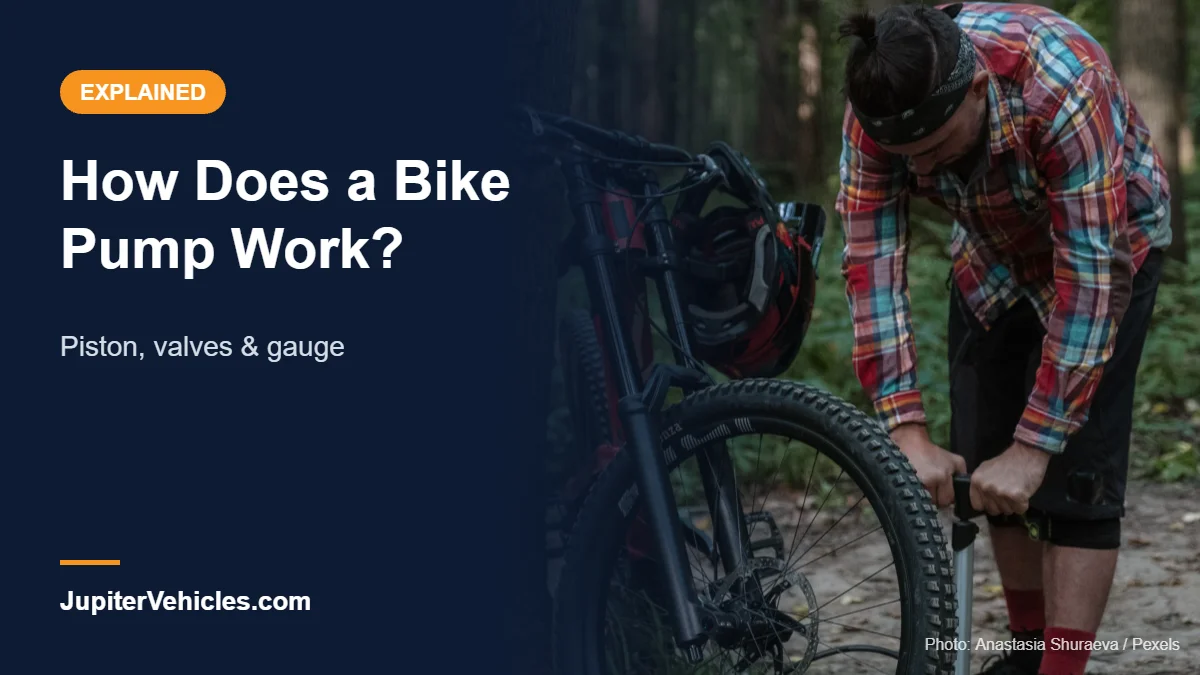
How Does a Bike Pump Work? A Simple Explanation
JupiterVehicles is reader-supported. As an Amazon Associate, we earn from qualifying purchases.
A bike pump works by trapping air in a cylinder and pushing it into your tire with a piston. A one-way valve lets air in from outside on each upstroke, and on the downstroke the piston forces that air through the hose and into the tube. Here’s each part in plain language.
Table of Contents
The Basic Idea
Wikipedia’s bicycle pump article describes a bike pump as a positive-displacement pump driven by a hand-operated piston:
- Upstroke: You pull the handle up. The piston draws outside air into the barrel through a one-way valve.
- Downstroke: You push the handle down. The piston squeezes that air out of the barrel, through the hose, and into the tire.
- Repeat: Each stroke adds a little more air, and the pressure in the tire rises.
The Main Parts
| Part | What it does |
|---|---|
| Barrel (cylinder) | Holds the air before each stroke |
| Piston and seal | Pushes the air out on the downstroke |
| One-way (check) valve | Lets air in, stops it leaking back out |
| Hose | Carries air from the barrel to the head |
| Pump head (chuck) | Seals onto the tire valve |
| Pressure gauge | Shows the tire pressure |
Why Pumping Gets Harder
As the tire fills, the air inside pushes back harder. Each stroke has to push against that rising pressure, so the last few strokes take the most effort. This is also why high-pressure road tires feel harder to pump than low-pressure mountain bike tires.
Barrel size matters too. A wide barrel moves more air per stroke but takes more force at high pressure. A narrow barrel moves less air but is easier to push at high pressure.
How the Pump Head Connects
The pump head has to match your tire valve. According to Park Tool, a Schrader valve has a spring-loaded core that the pump head presses open, while a Presta valve has a small locknut you unscrew before air can enter. Many pumps now have a head that fits both.
The Tire Valve Keeps the Air In
The pump only pushes air. Once it’s in the tube, the tire’s own valve stops it escaping. Schrader valves close with a spring. Presta valves are held closed by air pressure and the locknut.
How Different Pumps Work
- Floor pumps: Long barrel and big handle for fast filling. Most have a gauge.
- Mini pumps: Small barrel, so more strokes are needed. Built to carry on the bike.
- Double-action pumps: Push air on both the up and down strokes.
- CO2 inflators: Release compressed gas from a cartridge in seconds. No piston at all.
- Electric pumps: A small motor and compressor do the pumping for you.

- High-Pressure Performance: Delivers up to 160 psi (11 bar), read on an enlarged 3" mid-mount analog gauge for clear, accurate inflation on road, gravel or MTB.
- Universal TwinHead DX5: The hammer-style TwinHead DX5 fits Presta, Schrader and Dunlop valves, and the extra-long 360-degree hose reaches tires at any angle.
- Durable Steel Construction: A robust steel barrel and hardened steel base keep the JoeBlow Sport III stable during high-pressure fills, ride after ride.
- Ergonomic Comfort and Control: An oversized padded handle gives a comfortable, secure grip, reducing hand fatigue so every rider pumps up faster.
- Complete Accessory Set: Includes ball and bladder inflation needles and a built-in hose dock, making it ready for bikes, sports balls and inflatables.

A floor pump like the Topeak JoeBlow Sport III (about $65) is the easiest way to get accurate pressure. See our full best bike pump guide for more options.
FAQ
Why does my bike pump get hard to push?
The tire’s rising pressure pushes back on the piston. It’s normal for the last strokes to be harder.
Why does air leak when I remove the pump head?
A little hiss is normal as the hose empties. Remove the head quickly and straight to limit any loss from the tire.
Can a car tire pump be used on a bike?
Sometimes, if it fits the valve, but Wikipedia notes that service-station pumps can under-inflate or quickly over-inflate a bike tire. Use short bursts and check with a gauge.



One Comment