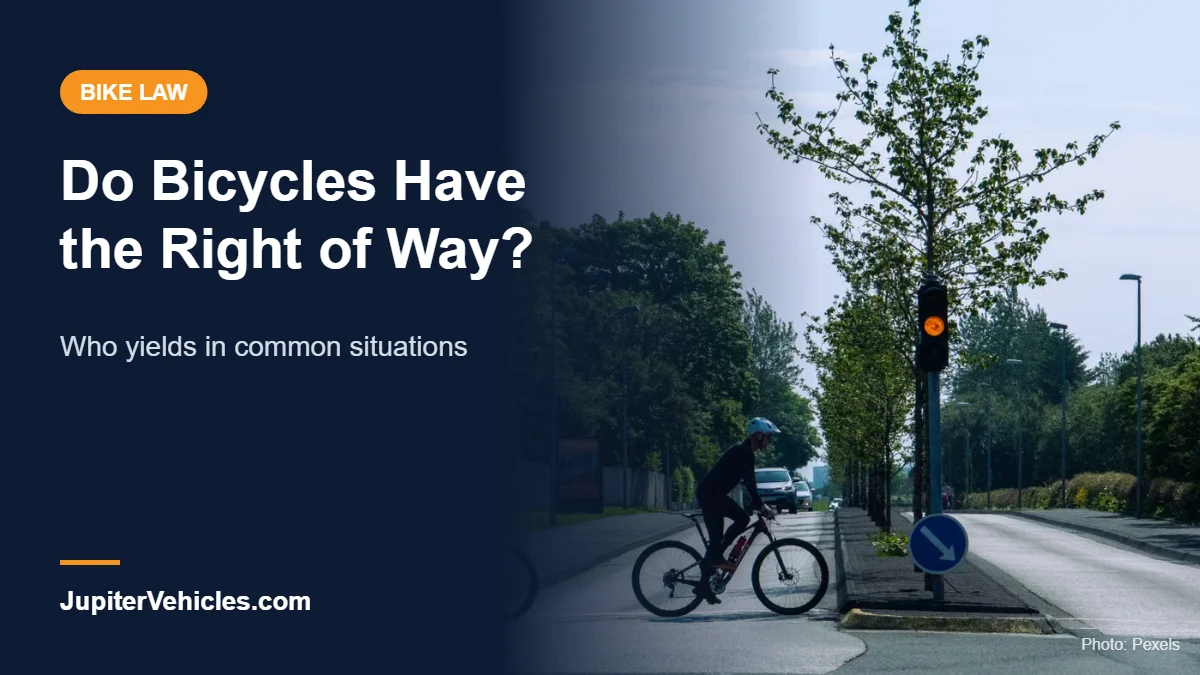
Do Bicycles Have the Right of Way? Who Yields in Common Situations
JupiterVehicles is reader-supported. As an Amazon Associate, we earn from qualifying purchases.
Not automatically. On the road, bicycles generally follow the same right-of-way rules as other vehicles: sometimes the cyclist has it, sometimes the driver does. NHTSA’s bicycle safety guidance points out that bicyclists failing to yield the right of way was the highest factor in fatal bike crashes, followed by bicyclists not being visible. Knowing who yields matters.
This is general information, not legal advice. Laws vary by state.
Table of Contents
The General Rule
In most states, cyclists on the road have the rights and duties of drivers. California’s Vehicle Code 21200 is an example. That means right-of-way depends on signs, signals and position, not on whether you’re on a bike or in a car.
Common Situations
| Situation | Who usually has the right of way |
|---|---|
| Traffic light | Whoever has the green, following turn rules |
| Stop sign intersection | First to stop. If simultaneous, the vehicle on the right |
| Cyclist going straight, driver turning right across them | Cyclist going straight, in most cases. Drivers must yield before turning |
| Cyclist turning left | Cyclist yields to oncoming traffic, like any vehicle |
| Entering from a driveway or parking lot | Traffic already on the road |
| Pedestrian in a crosswalk | Pedestrian. Cyclists and drivers yield |
| Shared-use path | Cyclists yield to pedestrians, usually announcing when passing |
What Drivers Should Do
NHTSA tells drivers to yield to bicyclists as they would to motorists, avoid turning in front of cyclists, look right and behind before turning right on red, and give cyclists room when passing.
What Cyclists Should Do
- Obey signals and stop signs.
- Ride predictably in the same direction as traffic.
- Signal and look over your shoulder before changing position or turning.
- Make eye contact with drivers when possible.
- Assume others may not see you, as NHTSA advises.
Having the Right of Way Isn’t Enough
Even when the law is on your side, being seen and riding defensively prevents crashes. Bright lights, especially daytime tail lights, help. See can bicycles ride on the road.

- Rearview radar with tail light provides awareness of vehicles approaching from behind up to 153 yards (140 meters) away
- Pairs seamlessly with your Edge bike computer and compatible smartphone as well as select Garmin wearables or the radar display unit
- When used with your compatible smartphone, the Varia app provides graphics — plus tone and vibration alerts — that indicate approaching cars
- When used with a compatible smartphone, Varia radar integrates with third-party apps such as Ride with GPS to overlay your maps with rearview radar alerts
- Daylight visibility up to 1 mile alerts motorists to your presence as soon as possible

A radar tail light like the Garmin Varia RTL515 warns you about vehicles approaching from behind.
Frequently Asked Questions
Do cars have to yield to bicycles?
When the cyclist has the right of way, yes, just as they would yield to another vehicle.
Do bikes have the right of way over pedestrians?
No. Pedestrians in crosswalks have the right of way, and cyclists should yield to walkers on shared paths.
Who has the right of way in a bike lane?
Cyclists in the bike lane, but drivers may cross it to turn or park after yielding. Rules vary by state.
Can a cyclist be at fault in a crash?
Yes. Cyclists must follow the same rules, and failing to yield is a major factor in fatal crashes according to NHTSA.
The Bottom Line
Bicycles don’t automatically have the right of way. They follow the same rules as other vehicles, yield to pedestrians, and have the right of way when the signals and situation give it to them. Ride predictably and be visible either way.