
Handlebar vs Helmet Bike Light: Pros, Cons & Which to Choose
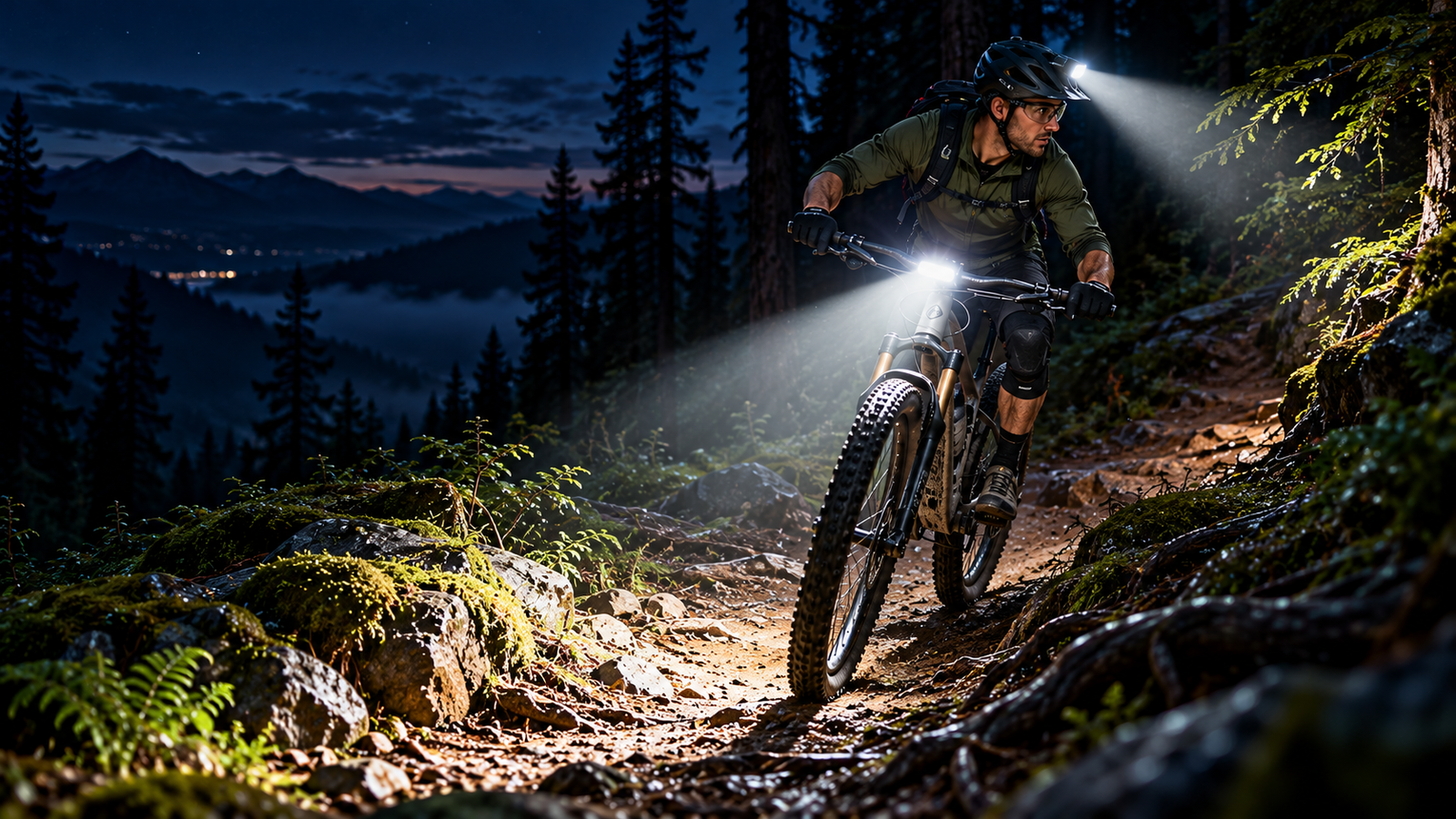
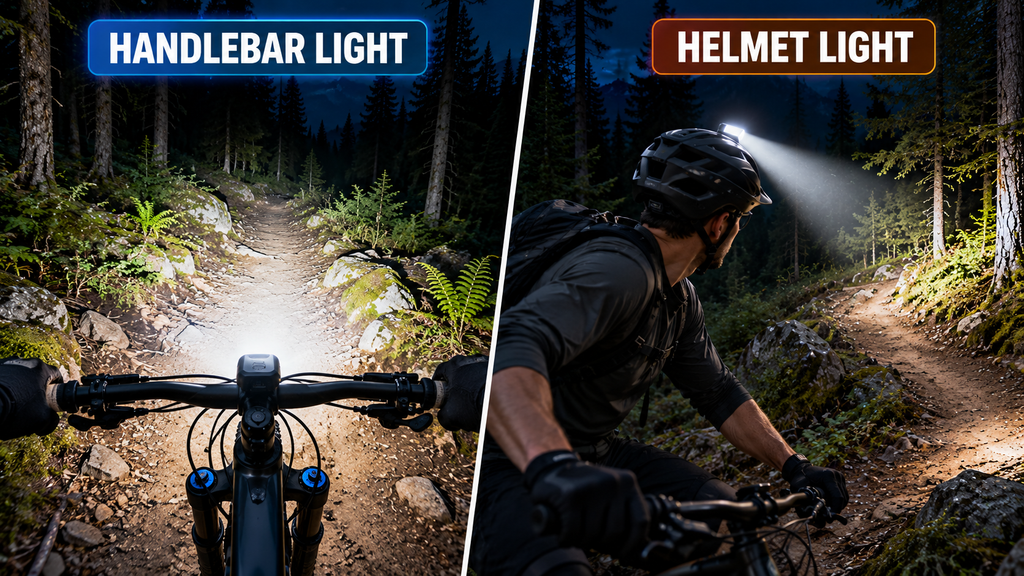
A handlebar bike light and a helmet bike light serve different purposes. A handlebar-mounted light illuminates the trail in the direction your bike is pointing, while a helmet-mounted light follows your head and helps you see where you look. For mountain biking on dark, technical trails, using both can provide more versatile illumination. If you want just one light, the better choice depends on your terrain, riding speed, beam pattern, and how you use your bike.
For regular mountain biking on unlit trails, a wide-beam handlebar light paired with a more focused helmet light is a practical setup to consider. REI and British Cycling both recommend considering this combination for nighttime trail riding. However, a single well-chosen light may be sufficient for slower rides on familiar, relatively straightforward paths.
This guide compares handlebar and helmet bike lights by their practical advantages, limitations, mounting requirements, battery considerations, and suitability for different riders.
Table of Contents
Quick Verdict: Handlebar vs Helmet Bike Light
- Choose a handlebar light if you want a stable beam to illuminate the trail ahead without carrying additional weight on your helmet.
- Choose a helmet light if you frequently look into corners, inspect side trails, or need illumination that follows your gaze.
- Consider using both for dark, technical mountain bike trails where you need broad foreground illumination and light directed farther along your intended line.
- Add a rear light when your route includes roads, shared paths, or other environments where visibility from behind matters.
Neither mounting option is universally superior. Beam quality, runtime, mounting security, and the conditions in which you ride can matter as much as the mounting position.
Handlebar vs Helmet Bike Light: Side-by-Side Comparison
| Comparison factor | Handlebar bike light | Helmet bike light |
|---|---|---|
| Mounting position | Bicycle handlebar | Helmet |
| Beam direction | Follows handlebar direction | Follows head direction |
| Main purpose | Illuminates the general trail ahead | Illuminates where the rider looks |
| Useful beam pattern | Often a broad, even beam | Often a more focused beam |
| Corner visibility | Depends on handlebar position and beam width | Can illuminate a corner before the bike turns |
| Depth perception | Can create useful shadows around trail features | Can fill in areas hidden by the handlebar beam |
| Weight | Added to the bicycle | Added to the helmet |
| Installation | Requires a compatible handlebar mount | Requires a secure, compatible helmet mount |
| Battery considerations | Depends on output and battery design | Depends on output, battery design, and helmet-mounted weight |
| Main limitation | Does not automatically follow the rider’s gaze | Adds weight to the helmet and can cause glare if misdirected |
| Best suited for | General trail illumination | Looking around corners and at specific features |
| Best overall use | Primary trail light for many riders | Supplementary light for technical riding |
These are general differences between mounting types, not specifications for every product. Some lights support multiple mounting options, and actual performance depends on the design.
What Is a Handlebar Bike Light?
A handlebar bike light attaches to the front of your bicycle, usually near the center of the handlebars. It directs light toward the trail ahead and moves with the bike’s steering direction.
For mountain biking, a handlebar light is often used as the primary source of illumination. A suitably broad beam can help reveal the trail surface, roots, rocks, and changes in terrain.
Advantages of a handlebar bike light
1. Stable trail illumination
The light generally follows the direction of the handlebars. This provides a consistent reference for illuminating the trail directly in front of the bicycle.
2. Broad foreground coverage
A light designed with a wide, even beam can illuminate more of the trail surface and its edges. This is particularly useful when navigating uneven ground or identifying nearby obstacles.
3. No additional weight on your helmet
The light and its battery are carried by the bicycle rather than directly on your head. For riders who dislike helmet accessories, this can be a meaningful comfort advantage.
4. Straightforward mounting
Many handlebar lights use clamps or brackets that attach to the bicycle’s cockpit. You should still verify handlebar compatibility and ensure the mount does not interfere with brake levers, shifters, cables, or other controls.
Disadvantages of a handlebar bike light
It does not follow your gaze. When you look into a sharp turn before steering, the light may continue pointing toward the trail entrance instead of illuminating the exit.
Beam coverage varies. A narrow beam can leave the trail edges poorly illuminated, even when the light has a high advertised lumen output.
Mount stability matters. Rough terrain and vibration can cause a poorly secured light to shift. Check the mounting system before riding.
Who should choose a handlebar light?
A handlebar light is a sensible starting point for riders who need general trail illumination, prefer not to carry extra helmet weight, or ride relatively straightforward routes at controlled speeds.
For dark mountain bike trails, prioritize a suitable beam pattern, adequate sustained output, reliable mounting, and realistic battery runtime rather than choosing by maximum lumens alone.
What Is a Helmet Bike Light?
A helmet bike light attaches to a compatible helmet and directs its beam according to the movement of your head. Unlike a handlebar light, it can illuminate the direction you are looking before you steer the bicycle toward it.
This makes helmet-mounted lighting especially useful on twisting trails, where looking ahead and anticipating a turn are important parts of riding.
Advantages of a helmet bike light
1. Follows your gaze
You can direct the beam toward a corner, a trail junction, or a feature you want to inspect. This is the helmet light’s most important advantage over a handlebar-only setup.
2. Helps illuminate technical features
On uneven trails, a helmet light can fill in areas that the handlebar beam does not illuminate well. The difference in lighting direction can help reveal additional details around obstacles.
3. Useful beyond forward riding
A helmet light can also help when you stop to inspect a trail feature, check equipment, or look around in a dark area, provided the light and mount are suitable for those uses.
Disadvantages of a helmet bike light
Additional helmet weight: The light and any attached battery add weight to your helmet. Comfort depends on the light’s design, mounting arrangement, and helmet fit.
Potential glare: Looking directly toward another cyclist can direct the beam into their eyes. Adjust the light responsibly and avoid shining it into the faces of other riders or road users.
Mounting compatibility: Not every light fits every helmet. Follow the helmet and light manufacturers’ instructions, and do not compromise the helmet’s fit or protective function.
Battery and cable considerations: Some systems use an integrated battery, while others use a separate battery pack and cable. The best arrangement depends on runtime needs, weight distribution, and personal preference.
Who should choose a helmet light?
A helmet light is worth considering for riders who frequently navigate tight corners, ride technical singletrack, or need to illuminate features away from the bicycle’s immediate steering direction.
However, it should not automatically replace a suitable bicycle-mounted front light when the latter is needed for trail coverage or to satisfy applicable local lighting requirements.
The 5 Most Important Differences Explained
1. Beam direction and trail coverage
The main difference between these lights is where they direct their beams.
A handlebar light illuminates the general direction of the bicycle. A helmet light illuminates the direction of your head. On a straight trail, those directions may be similar. On a tight turn, they can be very different.
For example, imagine approaching a sharp left-hand corner on a dark singletrack. You may look toward the exit before turning the handlebars. A helmet light can illuminate that area earlier, while a handlebar light continues illuminating the approach.
This is why many night-riding setups combine a broad handlebar beam with a more focused helmet beam.
2. Beam pattern matters as much as mounting position
The brightest light is not automatically the most useful light.
A wide beam can illuminate nearby obstacles and trail edges, while a focused beam can concentrate light farther ahead. The best choice depends on the terrain and the job the light needs to perform.
When comparing products, look for manufacturer beam-pattern information and runtime figures at the brightness setting you intend to use. A high maximum lumen rating alone does not establish how well a light will illuminate your trail.
3. Comfort and weight distribution
A handlebar light carries its weight on the bicycle, while a helmet light adds weight to your head.
Some riders may prefer the simplicity of a handlebar-only setup, especially on longer rides. Others may find the additional directional flexibility of a helmet light worth the weight.
If a helmet light feels unstable or affects the helmet’s fit, reconsider the mounting arrangement. Do not modify a helmet in a way that compromises its protective function.
4. Battery life and runtime
Neither mounting type guarantees longer battery life.
Runtime depends on the light’s output, battery capacity, electronics, operating mode, and other design factors. A helmet light with a smaller battery may last longer than a handlebar light if it uses less power, but that is not a universal rule.
Check the manufacturer’s runtime figures for the specific brightness mode you plan to use. Allow additional time for delays, route changes, and unexpected conditions, and consider carrying an appropriate backup light for longer rides.
5. Cost and overall value
The cost of a lighting setup depends on the products selected rather than the mounting position alone.
A single light may be more economical than buying two separate systems. However, if you frequently ride technical trails after dark, a second light may offer useful additional coverage.
Before purchasing, compare the complete setup, including compatible mounts, batteries, charging accessories, and any other required components. Without verified prices for specific models, it is not possible to identify a universal lower-cost winner.
Should You Use Both Handlebar and Helmet Lights?
For regular mountain biking on dark trails, using both is a practical option to consider.
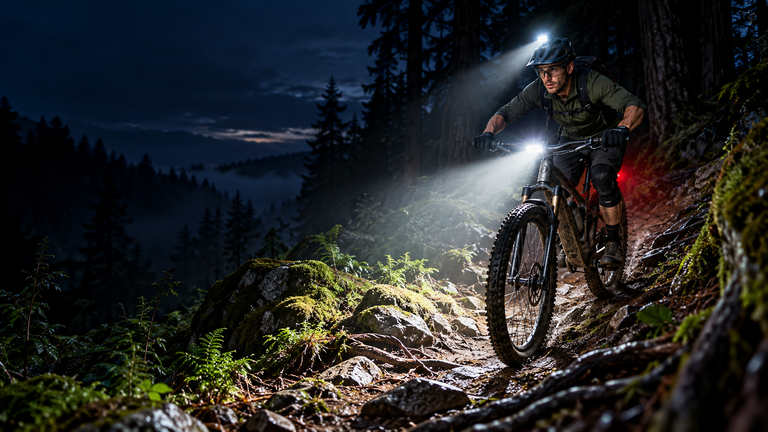
A handlebar light can provide broad illumination of the general trail, while a helmet light can direct a more focused beam toward corners and features you are looking at. Their different positions can complement each other.
A useful approach is to:
- Choose a handlebar light with a broad, even beam suitable for your trail.
- Add a helmet light with a beam pattern that complements the handlebar light.
- Aim the lights so they illuminate different useful areas instead of unnecessarily overlapping at very close range.
- Check both mounts for security before each ride.
- Carry sufficient battery capacity for the planned trip and a suitable backup when needed.
More light is not always better. Excessive brightness or poorly directed beams can create glare and make it harder for other riders to see comfortably. Test the setup in a safe area before riding unfamiliar or technical trails.
Which Bike Light Is Better for Different Riders?
Beginners
A handlebar light is a reasonable starting point because it provides general forward illumination without adding weight to the helmet. Choose a familiar route and ride at a speed that allows you to identify obstacles early.
A helmet light can be added as you progress to more technical terrain.
Riders on technical singletrack
A combination of handlebar and helmet lights is worth considering. The handlebar beam illuminates the main riding line, while the helmet beam helps you look through corners and inspect features beyond the steering direction.
Riders on familiar, easy trails
One suitable light may be enough for a slower ride on a relatively straightforward route. Evaluate ambient lighting, terrain, speed, and the light’s actual coverage before deciding.
Riders on long-distance night rides
Prioritize runtime, battery indicators, charging requirements, and backup lighting. A two-light setup is only useful if both lights can remain operational for the duration of the ride.
Riders who also use public roads
Consider front and rear visibility, beam direction, reflective accessories, and local bicycle-lighting laws. A helmet light should not be assumed to satisfy every legal requirement for a bicycle-mounted light.
Safety and Compatibility Checklist
Before buying or using either type of bike light, check the following:
- Mount compatibility: Confirm that the mount fits your handlebars or helmet and does not interfere with controls or helmet fit.
- Beam direction: Aim the beam to illuminate the route without unnecessarily dazzling approaching riders or motorists.
- Weather resistance: Check the manufacturer’s stated rating and limitations rather than assuming the light is waterproof.
- Battery runtime: Confirm the runtime at your intended brightness setting and allow a reasonable margin.
- Mount security: Check that the light cannot easily shift or detach over rough ground.
- Backup lighting: Consider a charged backup for remote or long rides.
- Rear visibility: Use appropriate rear lighting when traveling in environments where visibility from behind matters.
- Local rules: Verify the lighting requirements for your location and type of riding.
For MTB night riding, begin with a familiar, less technical route when testing a new setup. Reduce your speed if obstacles are difficult to identify, and do not assume that brighter lights make every trail safe at high speed.
Final Verdict: Handlebar vs Helmet Bike Light
For many mountain bikers, a handlebar light is the best starting point for general trail illumination, while a helmet light is a valuable supplement for looking into corners and identifying features away from the bicycle’s immediate direction.
If you ride dark, technical singletrack regularly, consider using both: a broad handlebar beam for the trail ahead and a more focused helmet beam for your line of sight.
If you only want one light, make the decision based on the type of riding you do, the light’s beam pattern, runtime, and mounting suitability. Neither option is universally best, and the most useful setup is the one that provides appropriate illumination for your route without compromising comfort or other riders’ visibility.
Is a handlebar or helmet bike light better for mountain biking?
For regular night mountain biking, using both can provide the most versatile coverage. A handlebar light illuminates the general trail, while a helmet light follows your gaze. For simpler routes, one suitable light may be sufficient.
Can I use only a helmet bike light?
A helmet light can illuminate the direction you look, but it may not provide the same stable, broad trail coverage as a suitable handlebar light. Consider the terrain, beam pattern, and local lighting requirements before relying on one light alone.
Should a helmet bike light be brighter than a handlebar light?
Not necessarily. The appropriate brightness depends on the beam pattern, terrain, and intended role of each light. A broad handlebar beam and a more focused helmet beam can complement one another without requiring either to operate at maximum output.
Does a helmet light improve visibility around corners?
It can help illuminate a corner earlier because it follows your head movement. The benefit depends on the light’s beam shape, positioning, and brightness.
Do I need a rear bike light for night riding?
A rear light is useful when riding on public roads, shared paths, or other routes where people may approach from behind. Check the applicable local rules and ensure the light is not blocked by clothing or bags.
Can any bike light be mounted on a helmet?
No. Check the light manufacturer’s mounting instructions and the helmet manufacturer’s guidance. Use a compatible mounting system without compromising the helmet’s fit or protective function.
One Comment