What Is a Car Scanner? Types of Car Diagnostic Scanners Explained
JupiterVehicles is reader-supported. As an Amazon Associate, we earn from qualifying purchases.
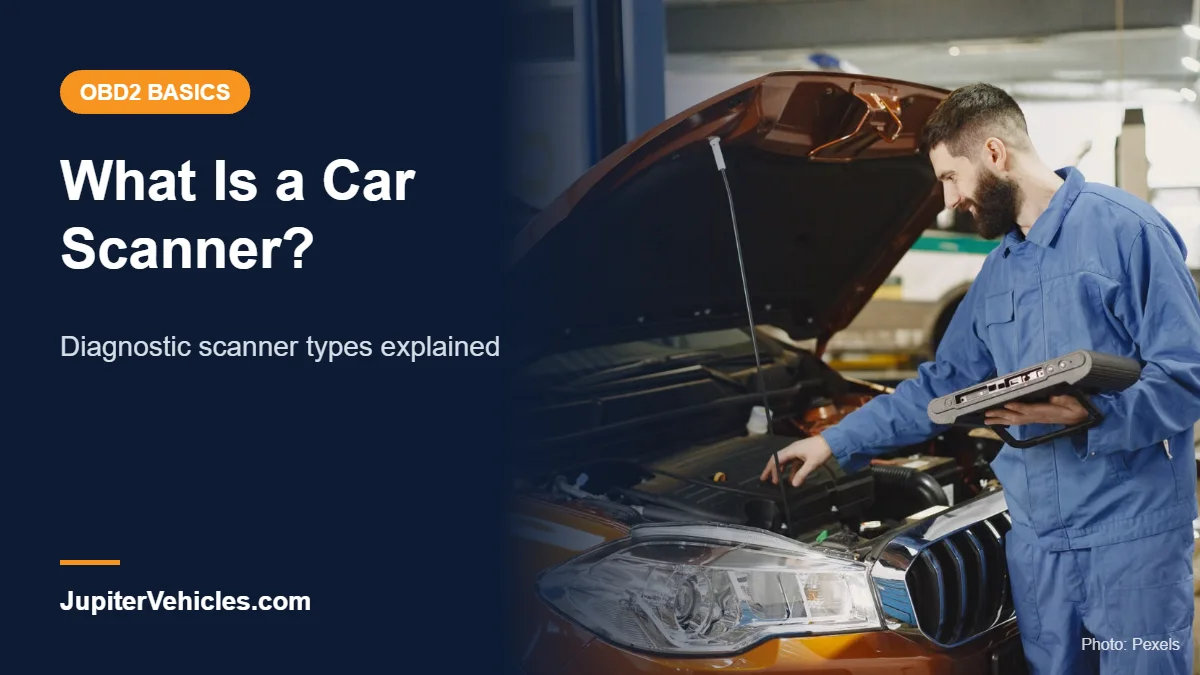
A car scanner is a diagnostic tool that connects to your vehicle’s computer and reads information about how its systems are working. The term covers a wide range of tools, from a $20 code reader that only reads check engine codes to professional scan tools that can test, program and code modules.
This guide explains the different kinds of car scanners and what each can access. For the narrower question of what a standard OBD2 scanner does, see what is an OBD2 scanner.
Table of Contents
Car Scanner: The Short Answer
A car scanner plugs into the vehicle’s diagnostic port (usually the OBD-II port under the dashboard) and communicates with the car’s control modules. Depending on the tool, it can read trouble codes, show live sensor data, check emissions readiness, reset service lights, and command components to run tests.
The Main Types of Car Scanners
1. Code Readers
The simplest car scanners. They read and clear engine and emissions trouble codes and turn off the check engine light after a repair. Most cost about $20 to $40.
2. OBD2 Scanners
A step up from code readers, with live data, freeze frame data, readiness checks and often battery tests. Some add ABS and airbag systems.
3. Bluetooth Scanners and Apps
A small adapter plugs into the port and sends data to a phone app. Some include their own app, while others work with third-party apps. See the best Bluetooth OBD2 scanners.
4. Bidirectional Scan Tools
These can send commands to the car, such as turning on a fan, cycling an ABS pump, or running an EVAP test. They’re popular with advanced DIYers.
5. Professional Diagnostic Systems
Tablet-based systems used by repair shops. They cover many brands and systems in depth and may support module programming and coding. They can cost thousands of dollars, sometimes with subscriptions.
What Each Type Can Access
| Feature | Code reader | OBD2 scanner | Bluetooth app | Bidirectional tool | Pro system |
|---|---|---|---|---|---|
| Engine codes | Yes | Yes | Yes | Yes | Yes |
| Live data | Rarely | Yes | Yes | Yes | Yes |
| ABS / airbag | No | Some | Some | Usually | Yes |
| Service resets | No | Some | Some | Yes | Yes |
| Bidirectional tests | No | No | Some | Yes | Yes |
| Coding / programming | No | No | Some, brand-specific | Some | Yes |
How Car Scanners Talk to Your Car
Every car and light truck sold in the U.S. since 1996 uses the standardized OBD-II connector and engine codes. The California Air Resources Board explains that OBD II monitors emissions-related components and turns on the check engine light when it finds a problem. That’s why even a cheap scanner can read engine codes on nearly any modern car. Access to other systems, like airbags or body controls, depends on manufacturer-specific software, which is where more expensive scanners earn their price.
Which Car Scanner Do You Need?
- You just want to know why the check engine light is on: a code reader or basic OBD2 scanner.
- You like seeing data on your phone: a Bluetooth scanner.
- You do your own brakes, batteries and maintenance: a scanner with ABS, battery and service resets.
- You diagnose complex problems: a bidirectional scan tool.
For specific models, see our guide to the best OBD2 scanners.
Car Scanner vs. Mechanic Diagnosis
A scanner gives you codes and data, not a final diagnosis. Mechanics use scanners plus testing equipment and experience to confirm the cause. Still, scanning first helps you understand the problem and ask better questions.

- 【2-IN-1 WIRED & BLUETOOTH OBD2 SCANNER】Get the reliability of a wired code reader and the convenience of Bluetooth app diagnostics in one compact tool. The ANCEL BD310 lets you read and clear check engine codes directly on the device or access advanced app features from your phone, including battery monitoring, smart driving insights, and live vehicle data. Designed for DIY drivers who want more than a basic scanner without stepping up to a professional tablet
- 【UNDERSTAND CHECK ENGINE LIGHTS BEFORE PAYING FOR REPAIRS】Stop guessing why your warning light is on. Read engine trouble codes, view plain-English DTC explanations, and use built-in Google Search support to learn possible causes and fixes before visiting a repair shop. Clear codes after repairs, verify the issue is resolved, and avoid unnecessary diagnostic fees and surprise repair costs
- 【MONITOR BATTERY HEALTH & VEHICLE PERFORMANCE】Track battery voltage in real time and spot charging system problems before they leave you stranded. The free app also includes battery testing, performance testing, and trip analysis tools that help you monitor driving behavior, coolant temperature, acceleration, braking, and overall vehicle health over time
- 【PASS SMOG CHECKS & EMISSIONS TESTS WITH CONFIDENCE】Run I/M Readiness checks at home before inspection day and avoid wasted trips to the testing station. Verify emissions monitor status, confirm O₂ sensor readiness, detect EVAP-related issues, and check whether your vehicle is ready for state emissions testing. A practical OBD2 scanner for routine maintenance, road trips, and everyday vehicle health checks
- 【SMART HUD DISPLAY & LIVE DRIVING DATA】Use HUD mode to display real-time speed, RPM, voltage, and other key vehicle data directly on your windshield or phone screen while driving. Customize dashboard layouts, monitor live performance data, and keep important vehicle information within view for a smarter and more connected driving experience
Frequently Asked Questions
Is a car scanner the same as an OBD2 scanner?
Most consumer car scanners are OBD2 scanners. “Car scanner” is a broader term that also includes professional tools and brand-specific systems.
How much does a car scanner cost?
Basic code readers start around $20. Bluetooth scanners run about $30 to $140, and advanced bidirectional tools cost more. See how much is a code reader for a car.
Can a car scanner tell me what’s wrong?
It tells you which system has a fault and gives data to narrow it down. You may still need tests to find the exact part.
Can I use a car scanner on any car?
Basic engine functions work on most 1996 and newer U.S. cars. Advanced features depend on the make and model.
The Bottom Line
A car scanner reads your vehicle’s computer to show trouble codes and data. Code readers handle the check engine light, Bluetooth and OBD2 scanners add live data and more systems, and bidirectional and pro tools add testing and programming. Pick the simplest type that covers the jobs you’ll actually do.