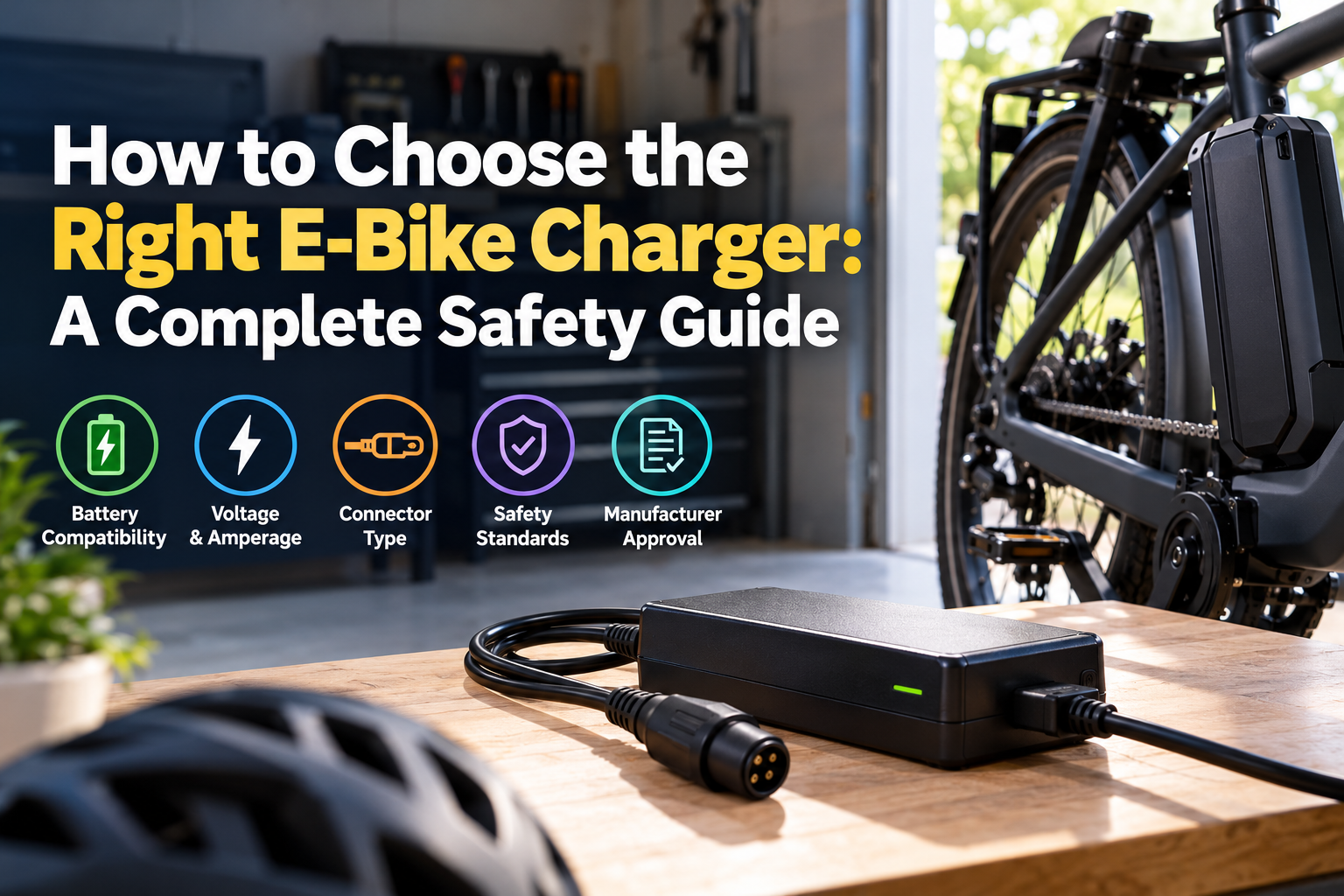
How to Choose the Right E-Bike Charger: A Safety Guide
Choosing the right e-bike charger involves more than finding a plug that fits your electric bicycle. The charger must be compatible with your specific battery and meet its electrical charging requirements. Using an unsuitable charger can damage the battery or create a serious fire hazard.
If you need a replacement charger, start with your e-bike manufacturer’s recommendations. Check the battery model, voltage, approved charger specifications, and connector type before purchasing anything. The safest choice is the original charger or a replacement explicitly approved for your particular battery system.
This guide explains how to choose the right e-bike charger, which specifications matter, common purchasing mistakes, and how to charge your battery safely.
Table of Contents
Why E-Bike Charger Compatibility Matters
An e-bike battery is a rechargeable electrical system with specific charging requirements. Its battery management system (BMS) helps monitor and protect the battery, but it does not make every charger safe to use.
A compatible charger must meet the battery manufacturer’s requirements for charging voltage, current, connector design, and charging behavior. Two chargers can look almost identical while having different electrical characteristics.
The U.S. Consumer Product Safety Commission (CPSC) has warned consumers about the risks of using universal chargers with e-bikes and other micromobility products when compatibility has not been established.
A charger can have a connector that physically fits while remaining electrically unsuitable. Therefore, never select a replacement based only on its price, appearance, or advertised compatibility with multiple brands.
Step 1: Identify Your E-Bike Battery
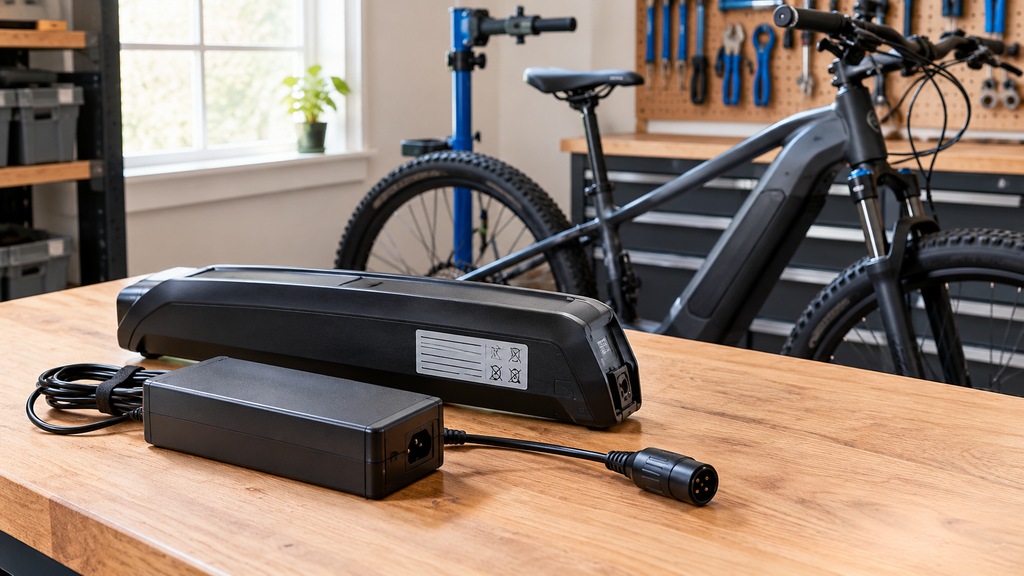
Before shopping for a replacement charger, identify the exact battery installed on your electric bicycle. Different e-bike models can use different battery systems, even when they come from the same manufacturer.
Check the battery label, owner’s manual, and original charger for the following information:
- E-bike manufacturer and model: Record the brand, model name, and model year if available.
- Battery model number: Look for the battery’s model or part number.
- Nominal voltage: Identify the battery’s rated operating voltage.
- Battery capacity: Record the amp-hour (Ah) or watt-hour (Wh) rating if listed.
- Original charger specifications: Check the charger’s output rating and model number.
Battery capacity helps estimate charging time, but it does not establish charger compatibility by itself. A battery’s watt-hour rating cannot tell you which connector, charging voltage, or charging profile is appropriate.
If the battery label is missing or unreadable, contact the manufacturer or an authorized dealer. Do not guess based on the battery’s physical appearance.
Step 2: Check Battery and Charger Voltage
Voltage is one of the most important specifications when choosing an e-bike charger. However, a battery’s nominal voltage and a charger’s output voltage are not necessarily identical.
For example, a lithium-ion battery described as a 36V battery needs a charger designed for that particular battery system. Its correct charging voltage depends on the battery chemistry, cell configuration, and manufacturer specifications.
The same principle applies to 48V and other battery systems. Do not assume that chargers with similar voltage labels are interchangeable.
How to Verify Voltage Compatibility
- Locate the nominal voltage on the battery label.
- Check the output-voltage rating on the original charger.
- Consult the e-bike owner’s manual or official charger documentation.
- Confirm that the replacement charger is approved for your exact battery model or system.
Important: Do not choose a charger simply because its voltage appears close to the battery’s nominal voltage. If you cannot confirm the required specifications, ask the manufacturer to identify the correct replacement.
Step 3: Understand Charger Amperage
Charger current is measured in amperes (A). It describes the current the charger is designed to supply under its specified operating conditions.
Charging current affects charging time, but it must also remain within the battery manufacturer’s approved limits. A charger with a higher current rating is not automatically a better choice.
Before purchasing a replacement, check:
- The original charger’s current rating.
- The maximum charging current permitted by the battery manufacturer.
- Whether the replacement is approved for the exact battery model.
- Any charging limitations listed in the owner’s manual.
If the manufacturer approves multiple chargers with different current ratings, choose one that meets the stated compatibility requirements and suits your charging needs. Do not assume that a lower-current or higher-current alternative is suitable without confirmation.
Step 4: Match the Charging Connector
The charging connector provides the physical connection between the charger and the battery or e-bike charging port. Electric bicycles use different connector designs, and similar-looking plugs may have different electrical arrangements.
Check the following details:
- Connector shape: The plug must use the approved connection type.
- Pin arrangement: The number and arrangement of contacts must match.
- Polarity: The electrical connections must follow the manufacturer’s design.
- Mechanical fit: The plug should connect properly without force or modification.
- Additional contacts: Some charging systems may use additional contacts or system-specific features.
A plug that fits the charging port does not prove that the charger is compatible. Never modify a connector, reverse wiring, or use an improvised adapter to make an unverified charger fit.
If you are unsure about the connector, contact the manufacturer with photographs of the battery label, original charger label, and charging port. Ask for the approved replacement part number.
Step 5: Verify Manufacturer Compatibility
Manufacturer approval should be the deciding factor when selecting an e-bike charger. This is especially important for proprietary battery systems and electric bicycles with integrated electronics.
Start with the original charger whenever possible. If it is lost or damaged, look for a replacement listed in the manufacturer’s official documentation or obtain confirmation from customer support or an authorized dealer.
Before purchasing, verify that:
- The replacement charger is approved for your battery or e-bike system.
- The charger model or part number matches the manufacturer’s recommendation.
- The output specifications agree with the official documentation.
- Any restrictions involving battery generation, model year, or charging system are satisfied.
- The seller provides credible compatibility information.
For example, Bosch eBike Systems’ official charger documentation provides system-specific guidance. This illustrates why compatibility should be checked against the relevant e-bike system rather than assumed from the brand name alone.
Do not assume that a charger from another bicycle made by the same company will work. Different battery generations and charging systems can have different requirements.
Step 6: Consider Charging Speed
Charging speed matters if you use your e-bike for commuting, delivery work, recreational rides, or frequent trips. However, the fastest advertised charger is not necessarily the correct option for your battery.
Charging time depends on several factors, including:
- Battery capacity and current state of charge.
- The approved charger’s output current.
- The battery management system and charging profile.
- Battery temperature and operating conditions.
- The charging behavior as the battery approaches full capacity.
A larger battery generally requires more energy to recharge than a smaller battery at a comparable state of charge. However, capacity alone cannot determine the exact charging time.
If your manufacturer offers multiple approved chargers, compare their documented charging times and current ratings. Choose an option that meets your needs without exceeding the battery’s approved charging limits.
For everyday commuting, a standard approved charger may be sufficient if your charging routine allows enough time. If you need shorter charging stops, check whether the manufacturer offers a faster approved option for your specific model.
Step 7: Check Safety Information
Electrical safety should be part of your purchasing decision. Before buying an e-bike charger, examine the manufacturer’s documentation, compatibility information, and applicable safety certification details.
Check whether:
- The charger comes from the e-bike manufacturer or a clearly identified supplier.
- The documentation identifies the intended battery or e-bike models.
- Any claimed safety certification can be verified through the relevant certification organization or documentation.
- The charger, cable, and connector arrive without visible damage.
- The seller provides clear warranty and return information.
Be cautious of listings that claim compatibility with dozens of unrelated brands without identifying the approved battery models.
A certification logo alone does not establish compatibility with your battery. You must verify both the charger’s safety credentials and its approval for your particular charging system.
Which E-Bike Charger Should You Choose?
The following comparison summarizes common charger options and the checks required before purchasing. It is a selection guide, not a recommendation for any specific product.
| Charger option | When to consider it | What to verify |
|---|---|---|
| Original manufacturer charger | Replacing a lost, damaged, or aging charger | Correct part number and battery-system compatibility |
| Manufacturer-approved replacement | When the original model is unavailable | Compatibility with the exact battery or e-bike system |
| Approved higher-current charger | When a faster charging option is explicitly supported | Approved charging current, battery limits, and model compatibility |
| Third-party charger | Only when the manufacturer confirms the specific model is suitable | Exact compatibility, output specifications, and verifiable safety credentials |
| Generic universal charger | Do not rely on a universal-compatibility claim alone | Specific testing and approval for your exact device |
How to Charge an E-Bike Battery Safely
Choosing the correct charger is only part of battery safety. The charging environment and your charging habits also matter.
1. Read the Owner’s Manual
Follow the manufacturer’s instructions for connecting the charger, charging the battery, and disconnecting the equipment. If the manual specifies a particular charging sequence, follow that sequence.
2. Inspect the Battery and Charger
Before charging, look for damaged cables, cracked housings, loose connectors, unusual odors, or signs of overheating. Do not use damaged charging equipment or a battery that appears swollen, leaking, or otherwise compromised.
3. Choose an Appropriate Charging Location
Charge in the location recommended by the manufacturer. Keep the battery and charger away from water, excessive heat, and flammable materials. Maintain any required ventilation and never cover a charger while it is operating.
4. Stay Present While Charging
The CPSC advises consumers to remain present while charging e-bikes and other micromobility products. Do not charge while sleeping or when you are away from home. Keep the charging area clear and avoid placing the equipment where a battery incident could block an exit.
5. Disconnect When Charging Is Complete
Follow the manufacturer’s instructions for identifying a completed charge and disconnecting the equipment. The CPSC advises unplugging the charger from the device when charging is complete rather than leaving it connected for extended periods.
6. Respond to Warning Signs
If the battery or charger develops an unusual odor, excessive heat, swelling, leaking, smoke, or other abnormal behavior, stop using the equipment if you can do so safely.
Do not touch a smoking or burning battery or attempt to carry it through your home. Move away, keep others clear, and contact emergency services if there is smoke, fire, or immediate danger.
Do not open the charger or battery, attempt internal repairs, or continue charging to see whether the problem disappears. Contact the manufacturer or a qualified e-bike technician for guidance.
Common E-Bike Charger Buying Mistakes
Choosing a Charger Based Only on Voltage
Matching the voltage label is not enough. The connector, current, charging profile, and manufacturer approval also matter. Confirm that the complete charger is suitable for your battery.
Assuming a Universal Charger Works With Every E-Bike
Universal-compatibility claims can be misleading. Even if the advertised voltage looks correct and the plug fits, the charger may not meet the battery’s charging requirements. Avoid unverified universal chargers.
Buying the Cheapest Replacement Without Checking the Seller
Price alone does not establish safety or quality. Check the manufacturer’s compatibility information, seller identity, warranty terms, and whether the charger can be traced to a legitimate supplier.
Using a Charger From Another Electric Bicycle
A charger from another bicycle should not be used unless the manufacturer confirms that the specific charger is compatible with your battery.
Modifying the Plug or Wiring
Cutting cables, changing connectors, reversing polarity, or improvising electrical adapters can introduce serious hazards. Obtain the correct replacement instead of modifying an unverified charger.
Ignoring a Damaged or Overheating Charger
A frayed cable, loose plug, cracked casing, burning smell, or unusual overheating is a reason to stop using the charger. Do not attempt to repair its internal electrical components yourself.
What to Do If Your E-Bike Charger Does Not Work
If the battery does not appear to charge, avoid immediately purchasing a more powerful charger. The problem could involve the power supply, connections, battery, charger, or another part of the e-bike system.
Check the Power Source
If there are no signs of damage or overheating, check whether the wall outlet is working using an appropriate method. Follow the charger’s instructions and do not use a damaged outlet or extension lead.
Inspect External Connections
Check the charging cable and connector for visible damage, debris, or looseness. Disconnect the equipment before inspecting it, and never insert metal objects into the charging port.
Consult the Charger Indicator
If the charger has indicator lights, check the owner’s manual to understand what each status means. Indicator behavior differs among models, so do not assume that a particular color or flashing pattern has the same meaning across brands.
Check the Battery Condition
If the battery is unusually hot, swollen, damaged, leaking, or producing an unusual odor, stop using it and seek manufacturer guidance. Do not attempt to revive a damaged battery with a different charger.
Contact the Manufacturer or a Qualified Technician
If the correct charger and power supply are being used but charging still fails, the problem may require professional diagnosis. A qualified technician can evaluate the charger, battery, charging port, and related electronics.
Frequently Asked Questions
1. How do I know which charger is compatible with my e-bike?
Check your e-bike model, battery model, original charger label, and owner’s manual. Verify the replacement charger’s exact compatibility with the manufacturer or an authorized dealer. Do not rely on connector shape or voltage alone.
2. Can I use a charger with the same voltage but a different amperage?
Not automatically. The charger must meet the battery manufacturer’s requirements for charging current and charging behavior. Use a different amperage rating only when the specific charger is approved for your battery system.
3. Can I use a universal e-bike battery charger?
Do not use a universal charger simply because it is advertised for e-bikes. The CPSC warns that chargers marketed as universal can be incompatible and create a fire hazard. Use the supplied charger or an exact replacement approved for your device.
4. Is a higher-amp e-bike charger better?
Not necessarily. A higher-current charger may reduce charging time when the manufacturer explicitly supports it, but it may be unsuitable for a battery that is not designed to accept that charging current. Follow the manufacturer’s specifications.
5. Can I use another brand’s charger on my e-bike?
Only if the e-bike or battery manufacturer explicitly approves that particular charger for your system. Brand names, matching voltage labels, and physically compatible connectors are not sufficient proof of compatibility.
6. Should I leave my e-bike battery charging overnight?
Do not charge while sleeping. The CPSC recommends remaining present during charging and disconnecting the device when charging is complete. Follow the manufacturer’s charging instructions and avoid leaving the battery connected for extended periods.
7. What should I do if I lose my original e-bike charger?
Contact the e-bike manufacturer or an authorized dealer with your bicycle and battery model numbers. Ask for the approved replacement charger and verify its part number before purchasing. Avoid guessing based on a similar-looking charger.
Conclusion
Learning how to choose the right e-bike charger starts with compatibility, not price or charging speed. Identify your battery, verify the approved charger model, check the required electrical specifications, and make sure the connector and charging system are correct.
The safest starting point is the charger supplied with your e-bike or a replacement explicitly approved by its manufacturer. Avoid unverified universal chargers, do not modify charging connections, and follow the manufacturer’s charging instructions every time.
A compatible charger helps you avoid preventable electrical hazards and supports reliable battery charging. When the specifications are unclear, contact the manufacturer before plugging in a replacement.