How to Use a Portable Jump Starter: 6 Simple Steps and Safety Tips
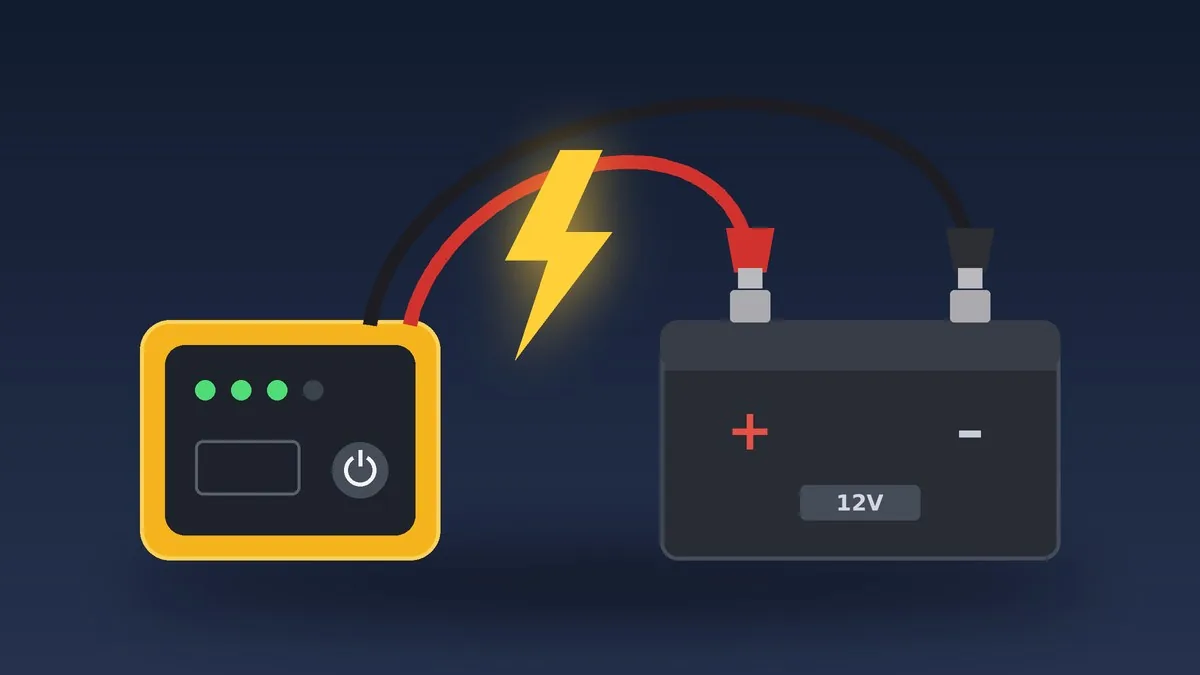
Here’s how to use a portable jump starter: make sure the pack is charged and the car’s ignition, lights, and accessories are off. Connect the red clamp to the battery’s positive (+) terminal, then connect the black clamp to bare metal on the engine block or chassis (or to the negative terminal, if your jump starter’s manual allows it).
Turn the pack on, wait for its “ready” light, and start the engine. Once it’s running, switch the pack off and remove the black clamp first, then the red one.
Below, you’ll also find how long to crank, what to do when the pack won’t switch on, and where the black clamp should go.
Table of Contents
Before You Use a Portable Jump Starter
These quick checks rule out the most common reasons a jump fails.
Is the jump starter charged? A pack that has been sitting in the trunk for months may not have enough left to crank an engine. Schumacher’s manual for its SL1689 pack says the internal battery should be at least 50% charged before you try a jump. Check the charge indicator before you open the hood. A jump starter is one of the car accessories worth buying, but only if it’s charged.

Is your vehicle a 12-volt system? Most cars, SUVs, and light trucks are. Many consumer packs are 12V only. NOCO’s GB40 user guide, for example, says not to use it on 6V systems, on 24V systems (including two 12V batteries wired in series), or on lithium starter batteries. Heavy trucks, some older classics, and some equipment fall outside what a typical pack supports.
Is the battery frozen, cracked, leaking, or swollen? If so, stop. NOCO’s guide says never to jump-start a frozen or damaged battery, and Schumacher’s manual warns against charging a frozen one. A frozen battery can rupture when current is forced through it.
Where is the battery? In many cars it’s under the hood. In others it’s in the trunk, under a rear seat, or under the floor, and the manufacturer provides remote jump-start terminals in the engine bay instead. If you can’t see a battery when you open the hood, check your owner’s manual for the jump-starting section before clamping onto anything.

Safety Gear and Setup
Lead-acid car batteries give off explosive gas during normal operation. That one fact explains most of the safety rules.
- Wear eye protection. Both manuals recommend it.
- Take off rings, bracelets, and metal watches. A dropped wrench or a ring that bridges a terminal can cause a spark or a short.
- Work in the open air, not in a closed garage.
- No smoking or open flames near the engine bay.
- Keep the clamps and cables away from the fan, belts, and pulleys, and make sure the hood can’t close on the cables.
- Never let the two clamps touch each other while connected to the pack.

Also turn off the headlights, radio, climate control, and anything plugged into a power outlet. NOCO’s instructions say to switch off all vehicle loads before you power on the pack, because you want every amp going to the starter motor.
How to Use a Portable Jump Starter, Step by Step
1. Identify the terminals
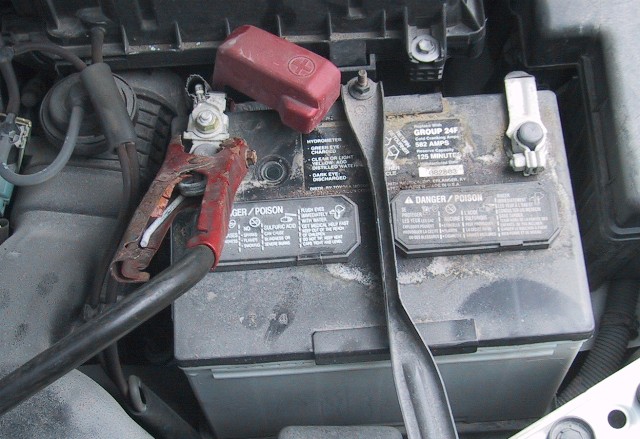
The positive terminal is marked “+”, “POS”, or “P” and often has a red cover. Schumacher’s manual notes that the positive post is usually larger in diameter than the negative one. The negative terminal is marked “–”, “NEG”, or “N”. If the terminals are crusted with white or green corrosion, wiggle the clamp jaws until they bite into clean metal. A poor connection can make a healthy pack look weak.
2. Connect the red clamp to positive (+)
Make sure the pack is switched off, and plug the clamp cable into the pack first if yours uses a detachable cable. Then attach the red clamp firmly to the positive terminal.
3. Connect the black clamp to a ground point
This is where instructions differ:
- Schumacher (SL1689 manual) says to connect the black clamp to the chassis or engine block, away from the battery, on a heavy-gauge metal part. Not the carburetor, fuel lines, or thin sheet-metal body panels.
- NOCO (GB40 guide) says the black clamp can go on the negative terminal or the vehicle chassis.
Grounding away from the battery is the more conservative option, because any spark at the final connection happens away from the gas the battery may be venting. If your pack’s manual and your vehicle’s owner’s manual both allow the negative post, it’s acceptable. If they disagree, follow the vehicle manual. Some newer vehicles specify a particular ground point for jump-starting.
4. Turn the pack on and wait for “ready”
Press the power button. Most smart packs run a quick self-check and then show a ready light. On the NOCO GB40, a white Boost LED means it’s ready, and a red error LED means the clamps are on backwards. Schumacher’s smart cable shows a green Ready LED.
If you see a reverse-polarity warning, switch off, swap the clamps, and try again. Packs with reverse-polarity protection won’t send current while the clamps are backwards.
5. Start the engine
Turn the key or press the start button as you normally would. Here’s the part where manufacturers give very different numbers, so check yours:
| NOCO GB40 | Schumacher SL1689 | |
|---|---|---|
| Before cranking | Most cars start right away; some need the pack connected up to 30 seconds first | Wait for the green Ready LED |
| Cranking time | Not specified | 5 to 8 seconds maximum |
| Wait between tries | 20 to 30 seconds | At least 1 minute |
| Limit | 5 attempts in 15 minutes, then rest the pack 15 minutes | 3 consecutive attempts, then see a technician |
The common thread: crank in short bursts and let both the pack and the starter motor rest in between. Holding the key for 20 seconds straight heats the starter and the pack’s cells and rarely helps.
6. Disconnect in reverse order
Once the engine is running, leave it running. Turn the pack off (or unplug the clamp cable from the pack, per your manual), then remove the black clamp first and the red clamp second. Keep the clamps apart as you lift them off.
When the Jump Starter Won’t Turn On or Show “Ready”
Smart jump starters need to detect some voltage in the car’s battery before they’ll send power. NOCO says the GB40 detects batteries down to 2 volts. Below that, the Boost LED stays off and the pack appears to do nothing, even though it’s working as designed.
Many packs have a manual override (sometimes called “boost” or “force start”) for this situation. On both the NOCO GB40 and Schumacher SL1689, you press and hold the override button for 3 seconds.
Be careful here. Override turns off the spark protection and the reverse-polarity protection. NOCO notes that the GB40 can deliver up to 1,000 amps in this mode. Before you use it:
- Double-check that red is on positive and black is on ground.
- Make sure the clamps can’t touch each other or the same piece of metal.
- If you’re unsure about polarity, don’t use override. Call for help instead.
A battery that has dropped below 2 volts has usually been fully drained for a long time or has failed internally. Even if override gets the car started, plan to have that battery tested soon.
If the Engine Still Won’t Start
Pay attention to what you hear when you turn the key:
- Single click or rapid clicking, no cranking: Recheck both clamps for a solid metal-to-metal bite. In cold weather, Schumacher suggests keeping the pack connected and turning on the headlights and accessories for one minute to warm the battery, then trying again. (This is specific to Schumacher’s instructions. NOCO’s guide says to switch loads off, so follow your own manual.)
- Engine cranks normally but won’t fire: The battery probably isn’t the problem. Fuel, ignition, or immobilizer issues won’t be solved by more jump attempts.
- Nothing at all, no lights, no click: Check the clamp connections and the pack’s charge. Also check for a loose or badly corroded battery cable.
- Still no start after the attempts your manual allows: Stop. Repeated attempts can overheat the pack and the starter. Schumacher’s manual says to consult a service technician at that point.
After the Car Starts
A jump starter isn’t a battery charger. NOCO says this directly about the GB40. It gives the starter enough power to crank, then the car’s alternator takes over.
Keep the engine running and, if you can, drive for a while rather than shutting it off right away in a parking lot. If the battery went flat for an obvious reason, like headlights left on overnight, a long drive or a proper battery charger may be all it needs.
If it died with no obvious cause, or if you’ve needed to jump it more than once recently, have the battery and charging system tested. Many auto parts stores offer this. Also check accessories that draw power while the car is parked, such as a hardwired dash cam running in parking mode. A jump starter will get you home, but it won’t fix a battery that can no longer hold a charge.
Keeping Your Jump Starter Ready
A jump starter that’s flat when you need it is just extra weight in the trunk. A simple habit: top it up whenever you check your tire pressure. The two manuals give different maintenance intervals:
- Schumacher SL1689: charge after purchase, after every use, and at least every 30 days, or whenever the charge drops below 75%.
- NOCO GB40: charge at least every 4 to 6 months. NOCO says it holds about 70% of rated capacity for up to a year.
Heat matters too. NOCO warns that a car interior can reach 50°C (122°F) within 10 minutes in direct sun, which is the top of the GB40’s storage range. Schumacher lists a storage range of -20°C to 45°C (-4°F to 113°F) for the SL1689.

If you live somewhere hot, keep the pack out of direct sun, or bring it inside during summer heat and put it back before a trip. NOCO also says to recharge only between 0°C and 40°C (32°F to 104°F), so let a hot pack cool before plugging it in.
Other rules from the manuals:
- Don’t try to jump through the car’s 12V accessory socket. NOCO specifically says not to.
- Never use a jump starter on a vehicle with the battery removed. Schumacher warns this can damage the electrical system.
- Lithium jump starters must be recycled, not thrown in household trash.
Common Mistakes
- Connecting black before red. Connect red to positive first, then black to ground. Disconnect in the reverse order.
- Leaving the headlights and blower on. That load steals current from the starter.
- Long cranking. Short bursts with rest periods work better and protect both the starter and the pack.
- Using override without checking polarity. That’s the one moment the pack’s protection is off.
- Assuming the pack fixed the problem. If the battery is failing, it will leave you stranded again.
When to Call a Professional
Call roadside assistance or a mechanic if the battery is visibly damaged, leaking, swollen, or frozen; if you can’t find the battery or the jump-start terminals; if your vehicle uses a 24V or dual-battery setup your pack doesn’t support; or if the car still won’t start after the number of attempts your pack’s manual allows.
Frequently Asked Questions
Can I connect the black clamp to the negative battery terminal?
Some manufacturers allow it. NOCO’s GB40 guide lists either the negative terminal or the chassis. Others, like Schumacher, specify the chassis or engine block away from the battery. Follow your pack’s manual and your vehicle’s owner’s manual.
How long should I leave the jump starter connected before cranking?
Usually no time at all. Most cars start immediately once the ready light is on. NOCO says some vehicles need the pack connected up to 30 seconds first.
Is it safe if the clamps touch?
On packs with spark-proof protection, touching clamps generally won’t spark while the pack is in normal mode. In manual override mode, the protection is off and the clamps must not touch.
Can I use a car jump starter on a motorcycle?
Only if the pack and your motorcycle’s manual both support it. Check the voltage (6V vs. 12V) and battery type. Some packs, including the NOCO GB40, are not designed for lithium starter batteries.
How often should I charge my jump starter?
It depends on the model. Schumacher’s SL1689 manual says monthly, while NOCO says every 4 to 6 months for the GB40. Using your pack’s own interval, and recharging after every use, is the safe default.
The Takeaway
Knowing how to use a portable jump starter mostly comes down to order: red to positive, black to ground, power on, start, then reverse it. What separates a quick fix from a frustrating one is following your own pack’s timing limits, knowing that a dead-flat battery may need manual override (used carefully), and keeping the pack charged and out of the heat between uses. Take two minutes to read your jump starter’s manual before you need it, not on the roadside.